
If you get paid by fans every month, on Patreon, OnlyFans, Substack, Ko-fi memberships or a similar platform, your income looks steady from the outside. It isn’t. Subscribers join and cancel every day, payouts land on the platform’s schedule rather than yours, and nobody withholds tax for you. Here is a simple system for turning that kind of income into a budget you can actually live on.
Step 1: Work out what one subscriber is really worth
Most people start with their headline price. That number is too high, because the platform takes its cut first.
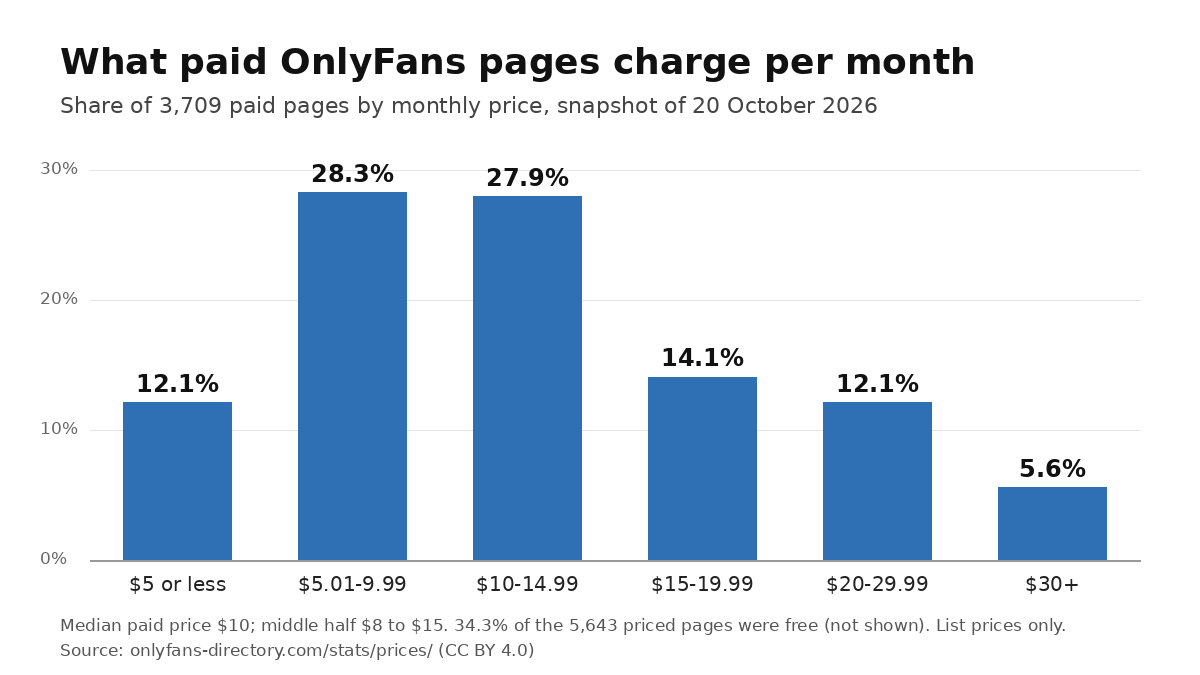
A useful reference point: in a snapshot of 5,643 public OnlyFans creator pages we compiled on 20 October 2026, 34.3% of pages were free to follow and the paid ones had a median price of $10 a month. The middle half of paid pages charged between $8 and $15. (The full breakdown is in our subscription price statistics.)
OnlyFans keeps 20% of subscription revenue, so a $10 subscriber is worth about $8 to the creator before tax. Other platforms take different cuts, and payment processing fees can apply on top, so check your own statements and use the net figure, not the sticker price.
Write down one number: your net income per subscriber per month.
Step 2: Budget from your floor, not your average
Subscription income moves around. A post goes viral and you gain 40 subscribers; a quiet month and you lose 25. If you build your budget on your best month, or even your average month, a normal dip turns into a missed bill.
Instead, find your floor:
- Pull your net payouts for the last 6 to 12 months.
- Take the lowest month, or the average of your two lowest months if you have a full year.
- That figure is your budget income.
Example (illustrative numbers): your net payouts over six months were $1,450, $1,180, $1,620, $1,240, $1,390 and $1,510. Your floor is $1,180. You budget as if you earn $1,180 a month and treat everything above it as extra.
If you are new and have fewer than three months of history, budget from your current subscriber count multiplied by your net per subscriber, then cut that by a quarter to allow for cancellations.
Step 3: Take tax out first, before it feels like your money
This is the step that catches most creators. Fan subscription income is self-employment income in most countries, and the platform usually does not withhold anything.
In the US, you owe self-employment tax of 15.3% (Social Security and Medicare) on net earnings, on top of regular income tax, and you are generally expected to pay estimated tax four times a year using Form 1040-ES. The IRS explains both on its self-employment tax page.
A practical habit:
- Open a separate savings account and name it “Tax”.
- Every time a payout arrives, move a fixed percentage into it straight away. Many self-employed people use 25% to 30% as a starting point; a tax professional can give you a figure that fits your situation.
- Pay your quarterly estimates from that account and nothing else.
Do this on payout day, not at the end of the month. Money that sits in your main account tends to get spent.
Step 4: Pay yourself a salary
Payouts arrive whenever the platform sends them, often weekly or on request. Your rent arrives once a month. A salary bridges the gap.
- Have all payouts land in one “Business” account.
- Move the tax percentage out immediately (Step 3).
- Once a month, on the same date, transfer a fixed salary to your personal account. Set the salary at or below your floor income after tax.
- Leave anything extra in the business account.
Now your personal budget sees one predictable deposit a month, just like a paycheck, and you can use any standard method, such as the 50/30/20 rule, on that amount.
Step 5: Build a buffer that matches your churn
A regular employee is often told to hold three to six months of expenses. If your income depends on fans renewing every month, aim for the upper end, and build it in the business account first.
The extra money above your salary goes to these, in order:
- A buffer of at least one month of salary, so a bad month never touches your personal budget.
- Then three months of salary.
- Then six months, plus any planned business costs such as equipment, editing help or software.
When the buffer is full, you can raise your salary or put the surplus toward savings goals. If a bad month drains the buffer, your salary stays the same; the buffer refills before you spend surplus again.
Step 6: Track the two numbers that move your income
Subscription income really comes down to two numbers: how many people subscribe and how much each one pays. Track them monthly in a simple spreadsheet:
- Subscribers at the start and end of the month
- New subscribers and cancellations
- Net income per subscriber
- Total net payout
After a few months you will see your normal churn rate. Say you usually lose 15% of subscribers a month. You then know you need roughly that many new ones just to stand still, and you can plan promotion around it instead of being surprised.
Step 7: Think twice before changing your price
When income dips, cutting your price is tempting. Do the maths first. Going from $10 to $5 halves what each subscriber is worth, so you need twice as many people just to earn the same. On the snapshot above, only 6.6% of paid pages charged under $5, and about a third sat between $5 and $10. A cheaper price can still work, but treat it as an experiment with a clear end date, not a panic move.
Raising prices has the opposite risk: some subscribers leave. Test any change on new subscribers first if your platform allows it, and compare your income per subscriber and your churn before and after.
A one-page summary
- Know your net income per subscriber after platform fees.
- Budget from your lowest recent month, not your best.
- Move a fixed tax percentage out on every payout day.
- Pay yourself a fixed monthly salary from a separate business account.
- Build a buffer of three to six months before raising that salary.
- Track subscribers, churn and income per subscriber every month.
- Treat price changes as tests, with numbers before and after.
Fan subscriptions can be a solid income. The difference between creators who feel in control and those who feel stuck usually isn’t how much they earn. It’s whether they separate tax, salary and buffer before the money gets spent.
About the author: Brian O. Thelander works on onlyfans-directory.com, an independent directory of public creator pages that publishes free data on subscription prices. This article is general information, not personal financial or tax advice.