Maria gets paid on the first of the month. By the twentieth, her bank account is almost empty. She can’t say where the money went. Rent, sure. Food, sure. The rest is just a blur of coffee runs and random store trips. I’ve been Maria. Most people have. That gap between “I make good money” and “I have no clue where it goes” is what the zero-based budgeting method fixes.
Here’s the idea. You take your money and give every dollar a job before the month starts. Rent gets a job. Food gets a job. Even your fun money gets a job, deliberately, not by accident. When you add it all up, you land on zero. Not because you spent every cent, but because every dollar savings included has somewhere to go.
What Is the Zero-Based Budgeting Method?
The zero-based budgeting method income minus spending lands on zero. Companies were doing this back in the 1970s, actually. The whole point was to make managers explain every cost instead of just rolling last year’s numbers forwards. People later used the same idea for their own money. It works just as well for a paycheck as it does for a company.
Here’s the part that makes it different from a normal budget. Nothing is on autopilot. You don’t assume last month’s plan still fits. You build a new one from scratch each month, based on what’s really coming in and going out.
How to Make a Zero-Based Budget
Making one isn’t about hard math. Start with your total income for the month. If your paychecks change, use the lowest number you might get. That way you won’t come up short. Next, write down every bill you already know is coming. Rent, power, food, gas, insurance, and any debt payments. These get paid first, since they keep the lights on.
Savings counts too, and this is the part people skip. Your emergency fund isn’t an extra. It’s a real line item, just like rent. Once your bills and savings are covered, split what’s left across the fun stuff. Eating out, hobbies, subscriptions. Keep going until the math hits zero.
Then track it as the month goes on. Move money around if you need to. If food costs more than planned, pull from a spot that has room. Don’t just guess and hope.
A Zero-Based Budgeting Example
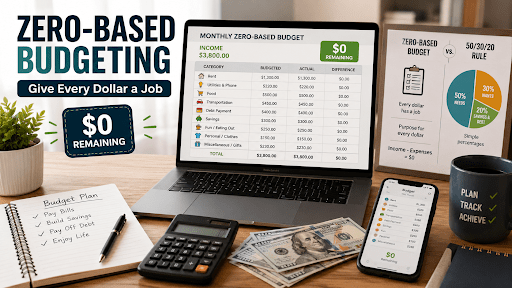
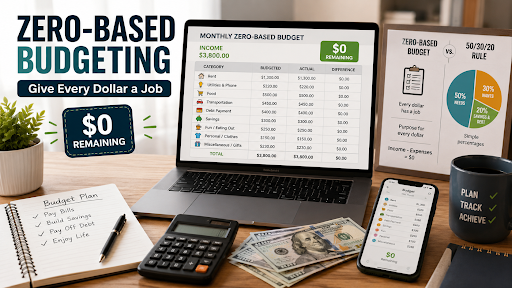
Take Marcus. He lives in Columbus, Ohio, and brings home $3,800 a month. His budget might look like this.
Rent takes $1,300. Power and phone cost $220. Food gets $500. His car payment and gas add up to $450. He puts $400 toward a credit card he’s paying off. Another $300 goes into savings. Fun stuff and eating out get $250. Clothes and personal spending get $150. Everything else, including gifts and smaller purchases, will receive the remaining $230.
Summarizing everything, you get $3,800.That matches his income to the dollar. Nothing is floating around, waiting to get spent on something he’ll forget by Friday. If Marcus gets a bonus next month, that bonus needs a job too. Maybe an extra debt payoff or a bigger deposit into savings.
Want to try it with your own numbers?
We have a zero-based budgeting calculator which calculates all for you while entering data.
Zero-Based Budget vs. 50/30/20
The 50/30/20 rule splits your money into three parts. Fifty percent for needs, thirty percent for wants, and twenty percent for savings and debt. It’s fast. It’s easy to remember. That’s why so many people start here.
A zero-based budget asks more from you. But it gives you more control in return. Instead of big buckets, every dollar gets its own job. This helps most if your income changes a lot, your debt is high, or you’re saving for something with a deadline. Round numbers don’t always match real bills.
New to budgeting? Start with 50/30/20. Already tried it and still feel stuck? The zero-based budgeting method will likely get you further.
Every Dollar Has a Job
You will come across this saying many times, and it works because of its true meaning. If each dollar has a function, you do not have any spare money. Cash that might get spent on something you’ll forget in a week. Every dollar goes toward a bill, a goal, or spending you actually planned. Simple as that.
It also stops the guilt. You’re not standing in line wondering if you can afford something. You already decided, back when you made the budget, how much that spot had.
Common Mistakes to Avoid
The biggest mistake is making the budget once and never touching it again. This method only works if you rebuild it every month. Bills and income change more than people think.
Second, people forget the odd expenses. Car repairs, birthdays, and yearly subscriptions. Then the bill shows up and it’s in panic mode. Give annual and irregular expenses their own line, even a small one, so they’re not ambushing you every few months.
And here’s the one that gets almost everyone: the fun-money category gets set too tight, and by week two the whole thing’s abandoned. Leave room to actually enjoy your money a little.
Is a Zero-Based Budget Right for You?
Do you like having a plan? Don’t mind spending twenty minutes a month on it? Then this will likely work well for you. Would you rather set something up once and mostly forget about it? A simpler method might fit better, at least to start.
Either way, this month is a fine time to try it. Pick your income number. List your bills. Give the leftover dollars a job. Our free budgeting worksheet can help you start right now. You might be surprised where your money has really been going.
The Consumer Financial Protection Bureau says tracking both income and spending is the first real step toward a budget that lasts past week one. That’s exactly what the zero-based method makes you do from day one.
Try it for one month. Then come back and check your numbers with our budget tracking tools to see how close you landed to zero.
FAQ
What is zero-based budgeting?
Income minus spending equals zero. That’s the whole idea. Every dollar has a job before the month starts rent, groceries, savings, whatever so nothing’s left floating around unassigned.
Is it suitable for beginners?
It may work out well, though it is more practical compared to the 50/30/20 method. In case you have never tried budgeting before, do not think that you must begin with this one.Track your spending for a month or two first. Once you actually know where the money’s going, zero-based gets a lot easier.
How’s it different from a regular budget?
A regular budget usually just copies last month with minor tweaks. Zero-based starts over every time nothing carries forward unless you decide it should.
Can zero-based budgeting work with income that changes?
Yes, and it’s actually one of the better methods for this. Base your budget on your lowest expected income. Then give any extra money a job as it comes in, usually savings or debt.
How long does it take to build a zero-based budget each month?
Most people spend fifteen to thirty minutes once they have their bills and income written down. It gets faster each month as the categories become second nature.