Maria works the morning shift at a diner in Toledo. She takes home about $1,900 a month, and until last spring, $310 of that was disappearing into two credit cards every single month. Most of it wasn’t even touching the balance. It was just interest, keeping the debt exactly where it was.
If that sounds familiar, you’ve probably already heard the standard advice and rolled your eyes at it. Skip the coffee. Cancel a streaming service. Sure, that might free up ten bucks. It’s not going to make a dent in $4,000.
So here’s how to pay off debt fast with low income, minus the parts that only work if you already have money to spare.
Start By Writing Down What You Actually Owe
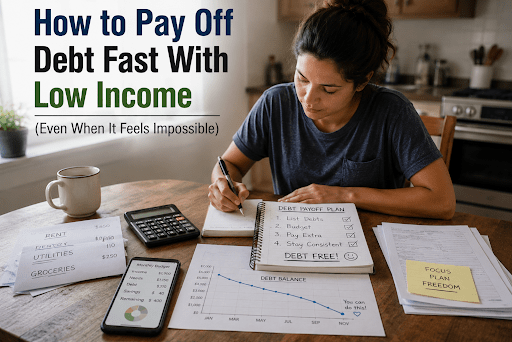
This step gets skipped a lot, mostly because people don’t want to see the total. I get it. Maria didn’t either. But grab a notebook, or a blank note on your phone, and list every debt. Creditor, balance, interest rate, minimum payment. Include the $200 you owe your sister. Include the medical bill you’ve been ignoring in a kitchen drawer.
When Maria finally added hers up, it came to $6,380. Writing it down didn’t make the number smaller. It just stopped being a fog she was avoiding. Once you can actually see what you’re dealing with, you stop reacting to bills and start working a plan instead.
Build a Budget That Isn’t Fantasy

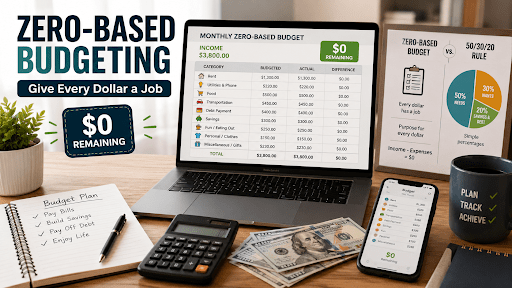
A lot of budgeting advice assumes you have room to breathe. If you’re working with a low income, your budget has to be tighter and a little more uncomfortable, at least for a while. Three categories: needs, debt, and everything else.
Needs first. Rent, utilities, groceries, and getting to work. Debt payments second, and they need a real dollar amount attached, not “whatever’s left over. ” Everything else gets whatever’s actually left, which for a while might be close to nothing. That part’s rough. It’s also temporary.
The CFPB has a free budget worksheet built for exactly this kind of month-to-month tightness, not the version of budgeting where you’re deciding between two vacation destinations. If you want something built specifically around debt payoff, FinanceCash has templates with a line for irregular expenses, which is usually the thing that wrecks a budget by day twenty.
Pick Snowball or Avalanche and Actually Use It

Two common approaches here. Snowball has you attack your smallest balance first while paying minimums on everything else, then roll that payment into the next smallest once it’s gone. Avalanche targets your highest interest rate first instead, which technically saves you more money.
I’ll be honest, avalanche is the “correct” answer on paper. But Maria used a snowball, and it worked, because she needed to see a win fast, or she was going to lose steam. Her smallest debt was a $310 store card charging 24% interest.Six weeks and another $50 per month after that, it was gone. One little success made those next ten months fly by in a way that no spreadsheet ever could.
Choose the one that you will be able to stick to.The “optimal” plan that you abandon in month three helps you less than a decent plan you follow for a year.
Find Extra Money Without Wrecking Your Week
You don’t need a second job to move faster here, though it can help if your schedule allows it. Start with what’s already leaving your account. Cancel the subscription you forgot you had. Call your insurance company and just ask if there’s a lower rate available. Check whether your state runs a utility assistance program, because a lot of people qualify and never apply.
If you’ve got a few spare hours, selling stuff adds up faster than you’d think. Maria sold an old bike and a couple of small appliances she never used, which put $140 straight onto her second debt. Not life-changing on its own, but paired with the budget, it shaved almost a month off her timeline.
Gig work is another option if your schedule has any given in it. Delivery apps usually pay out same-day, which actually matters when you need cash now instead of on the next pay cycle. Even five hours a week at $16 an hour works out to roughly $320 a month. That’s a more useful number than the vague “earn some extra income” line most articles leave you with.
Should You Consolidate?
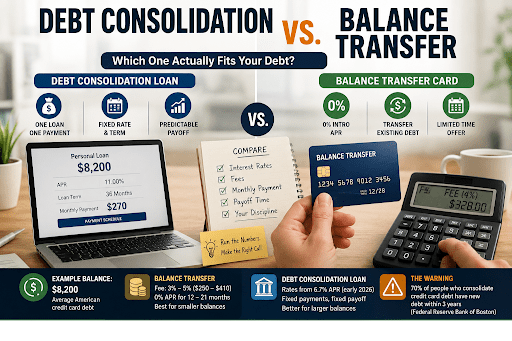
Debt consolidation means rolling several debts into one loan, ideally at a lower rate than you’re currently paying across the board. Sometimes that’s genuinely useful. Sometimes it’s just moving the same problem to a different lender with better marketing.
Check three things before you sign anything. Is the new rate actually lower than your current average? Does the loan term drag out so long you’d end up paying more total interest anyway? Is there an origination fee quietly eating whatever you’d save? Credit unions tend to beat the lenders advertising on daytime TV, especially if you’ve already got an account with one.
Maria looked into it and passed. Her balances were small enough that Snowball got her there without adding a new loan to track. If you’ve got debt scattered across five or six cards at wildly different rates, consolidation might be worth it. Two or three balances? You might not need it at all.
Call Your Creditors Before You’re Behind
This one gets skipped constantly, and it shouldn’t be. Credit card companies would rather work something out with you than lose the payment entirely. They’d rather get 60% of what you owe on a modified plan than 0% because you stopped answering the phone. Call the number on your statement. Ask about a hardship program, a lower rate, or a temporary reduced payment. Worst case, they say no, and nothing changes.
When Maria called her second card’s company, they dropped her rate from 26% to 14% for a year, just because she asked and had never missed a payment. That one phone call did more for her than any amount of coupon clipping.
Get Free Help Instead of Paying Someone
Nonprofit credit counselors will build a payoff plan with you for free or close to it. The National Foundation for Credit Counseling offers assistance from certified counselors who may help reduce interest rates by negotiating directly with creditors for a very low fee each month which will be much lower than the interest you are now paying.
Stay away from for-profit debt relief companies offering to eliminate your debt at one flat fee.Some are fine. A lot aren’t, and they can tank your credit score while charging hundreds of dollars for it. If the person wants money before doing anything for you, that’s something to think about.
Stay Away From the Traps
It is easy to fall into payday loans and buy-now-pay-later traps. They’re usually the opposite. Some payday loans carry interest rates north of 300% a year. If you’re actually working through how to pay off debt fast with low income, a payday loan is like bailing water into a boat that already has a hole in it.
Cash advances on a credit card are the same trick as wearing a different outfit. It feels like moving money around, but you’re just stacking a new, more expensive debt on top of an old one. If an emergency hits and you’re truly out of options, call a local nonprofit or church assistance program before you call a payday lender. A lot of communities have emergency funds that don’t get advertised anywhere but do exist.
Build a Tiny Emergency Fund Anyway
I know it sounds backward to save while you’re still in debt. But even $500 changes the whole equation. Without it, one flat tire or one sick kid sends you right back to the credit card. Maria put away $15 per week on autopilot without thinking about it, which ended up amounting to $780 over the course of the year. When her car battery died in February, she paid cash rather than using plastic.
Two weeks’ savings were lost during December since the holidays drained her budget. No problem.This isn’t about a perfect streak. It’s about the money being there more often than it isn’t.
There’s also a decision worth thinking about here: where does that emergency fund actually live? Not in your checking account, where it’s one impulse buy away from disappearing. A separate savings account, even at the same bank, works better because it’s just annoying enough to access that you won’t touch it for anything but a real emergency. Maria kept hers at a different credit union entirely, mostly so she wouldn’t see the balance every time she checked her main account.
Put the Numbers Somewhere You’ll Actually See Them
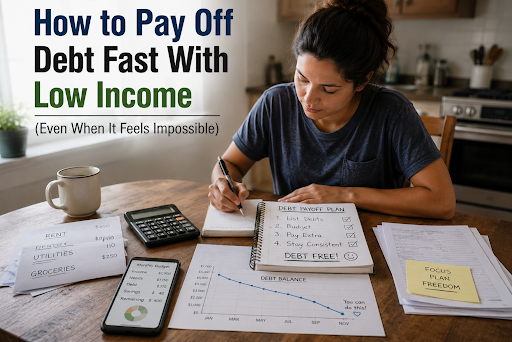
A sticky note on the fridge. A recurring phone reminder. Whatever works for you. Watching the total drop, even slowly, is what keeps most people from quitting around month four. Maria updated a simple chart on her fridge every payday. Nine months in, her $6,380 was down to $2,100. Not debt-free yet, but close enough to see the finish line, and that mattered more than she expected it to.
Want a printable version? FinanceCash has a free debt payoff tracker built for exactly this.
Automate What You Can
Set up autopay for your minimum payments. Even $25 a week. I know that sounds too simple to matter, but money you never see is money you can’t spend on something else. Maria set hers to pull every Friday, the same day she got paid, so the cash never sat around long enough to tempt her.
Here’s the part people skip: autopay protects your credit score more than almost anything else you’ll do in this whole process. One missed payment, just one, and that 30-day late mark sits on your report for years. If you’re working out how to pay off debt fast with low income, a hit like that can undo months of progress right when you need a decent score to qualify for a lower rate.
You don’t need an app or a course for this. Five minutes in your banking app and it’s done. If handing over full control feels risky, start smaller. Automate the minimum only, then add extra payments by hand once you trust yourself with it. It’s not glamorous. It’s just one less thing to forget on a week when everything else is falling apart anyway.
The Bottom Line
This takes longer than a headline makes it sound, and that’s okay. What matters is that you’re actually moving instead of treading water. List what you owe. Build a real budget around it. Pick a payoff method. Make that one phone call to your creditors this week. None of it requires income you don’t currently have. It just requires a plan, and now you’ve got one.
Ready for the next step? FinanceCash has free calculators and worksheets built around how to pay off debt fast with low income, with no email required to use them.
Frequently Asked Questions
What should I ask my creditor when I call about a lower rate?
Ask directly about a hardship program, a temporary reduced payment, or a lower interest rate, especially if you’ve never missed a payment. Companies would rather work something out than lose the payment completely.
Is it worth negotiating credit card interest rates myself, or do I need a company to do it?
You can absolutely try it yourself first. A single phone call, especially with a clean payment history, sometimes cuts your rate significantly. Save the paid negotiation services for situations where self-negotiation genuinely hasn’t worked.
How do I know if a debt settlement company is legitimate?
Be cautious of any company asking for money upfront before doing anything on your behalf. Some are fine, but plenty charge hundreds of dollars while tanking your credit score in the process. A nonprofit credit counselor is almost always the safer first call.
Can selling stuff around my house actually make a dent in my debt?
It won’t erase a large balance on its own, but a couple hundred dollars from things you’re not using anyway can shave real time off your payoff timeline, especially stacked on top of a working budget.
Is gig work worth it if I’m already working full time?
Only if your schedule genuinely has room. Even five hours a week at a modest hourly rate adds up to a few hundred extra dollars a month, which is a lot more useful than the vague advice to just “earn more.”
How much debt is too much for a snowball to realistically work?
There’s no hard cutoff, but if you’ve got debt scattered across five or six cards at wildly different interest rates, it’s worth at least comparing consolidation against snowball before committing to one path.