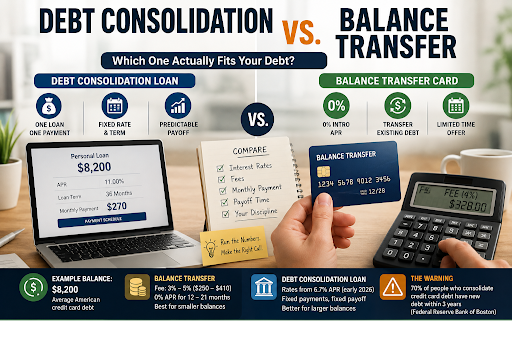
Marcus carries three credit cards and has roughly $8,200 in debt among them, putting him right at the average American credit card debt level for today. Marcus makes some payments on each card every month but doesn’t think he’s getting anywhere. His friend suggested that he should get a balance transfer card, while his colleague said that Marcus should look into getting a debt consolidation loan instead. Neither of them explained themselves further, and Marcus got even more confused.
This is a regular situation. Let’s get it straight then. Here’s debt consolidation vs. balance transfer simplified with numbers and facts.
What Each One Actually Is
In a balance transfer, the money owed on your credit cards is transferred to one new credit card, which may have a low-interest rate or 0% interest for a period of time. It is the same kind of credit card but only the interest rate varies.
In contrast, a debt consolidation loan involves borrowing a lump sum from a financial institution and using that money to settle your debts, including credit card debts. After this, you will be repaying one lender instead of repaying three.
The objective behind both these loans is the same. They just get there in different ways.
The Real Math on a Balance Transfer
Say Marcus moves his $8,200 to a card with a 0% intro rate for 18 months. Most balance transfer cards charge a fee upfront, usually 3% to 5% of what you move. On $8,200, that’s roughly $250 to $410 added right away.
If Marcus pays around $460 a month, he clears the balance before the 0% rate ends and pays almost nothing in interest. That’s the best case. The catch: if he doesn’t finish in time, the rate jumps back up, often above 20%, and whatever’s left starts collecting interest fast. Miss a payment, and some issuers end the 0% rate early too.
The Real Math on a Debt Consolidation Loan
A personal loan works differently. As of early 2026, the best rates for well-qualified borrowers start around 6.7% APR, though your rate depends on your credit score. Say Marcus qualifies at 11% APR over three years. His fixed payment lands around $270 a month, and he knows exactly when he’ll be done, with no countdown clock on a promo rate.
The tradeoff: he’s paying interest the whole time, unlike a 0% card. But that rate is locked in, and there’s no cliff waiting at month 19 if life gets in the way.
When Each One Makes More Sense
A balance transfer works best when your debt is small enough to realistically pay off during the promo window, and your credit score qualifies you for a good offer. If Marcus could pay $460 a month and finish in 18 months, that route saves more, fee included. It’s a weaker fit for larger balances, since promo periods run 12 to 21 months, and paying off a big number that fast takes payments most budgets don’t have room for.
A loan tends to fit better for bigger balances or anyone who knows they need more than a year and a half to get debt-free. The fixed rate also helps people who’ve struggled with the discipline a 0% window demands, since there’s no ticking clock punishing a slow month. Origination fees exist here too, usually 1% to 8% of the loan, so check the total cost, not just the monthly payment.
The Warning Both Options Share
Here’s something worth sitting with.According to research conducted by the Federal Reserve Bank of Boston, about 70% of consumers who consolidated their credit card debts ended up having new credit card debts in less than three years. Debt consolidation will not help solve the problems that caused the accumulation of debt. If the old cards stay open and active after you move the balance, it’s easy to end up with both the new payment and a fresh pile of card debt.
Whichever route you pick, closing or freezing the old cards, or at least setting a hard rule not to use them, matters as much as the interest rate does.
The CFPB’s guide on consolidating credit card debt breaks down the fine print on both options in plain language, worth a read before signing anything.
Watch for Debt Relief Scams
Legitimate debt relief never asks for payment before doing anything, never calls out of the blue promising a “new government program,” and never guarantees a specific result. If an offer does any of those, treat it as a red flag, per FTC guidance.
What Marcus Did
He ran the numbers on both. His balance was manageable enough, and his credit was strong enough that the balance transfer route saved him more, as long as he stuck to the plan. He set up automatic payments so he wouldn’t miss the 18-month window, and he cut up (not closed) his old cards so he wouldn’t be tempted to use them.
FinanceCash has a free calculator that runs this same comparison with your own numbers, showing the true cost of each option side by side instead of guessing which one sounds better.
The Bottom Line
Debt consolidation vs. balance transfer isn’t about which one is universally better. It’s about your balance size, your credit score, and whether you can realistically pay it off before a promo rate expires. Run your actual numbers before deciding, and whichever you pick, deal with the spending habits underneath the debt too, or you’ll likely be right back here in a few years.
FinanceCash also has a free debt payoff tracker to keep you on pace once you’ve made your choice and a budget planner to make sure the old cards don’t creep back up while you pay down the new one.
Frequently Asked Questions
Is a balance transfer or debt consolidation loan better for credit card debt?
It depends on your balance size and credit score. Balance transfers tend to save more on smaller debts you can pay off within the promo period, while consolidation loans fit better for larger balances or longer payoff timelines.
How much does a balance transfer cost?
Most balance transfer cards charge a fee of 3% to 5% of the amount transferred, added to your balance even during the 0% promotional period.
What happens if I don’t pay off my balance transfer in time?
The interest rate skyrockets to the normal rate of the card, which is usually above 20%, and charges begin accumulating based on the remaining balance.
Does debt consolidation lower my credit score?
Although there might be a temporary decline due to the hard credit pull that comes with applications, having less debt in general is good for your credit score.
Will debt consolidation put an end to my debt problem?
Only if paired with a change in spending habits. Research shows a majority of people who consolidate credit card debt build up new balances within a few years if the underlying habits don’t change.