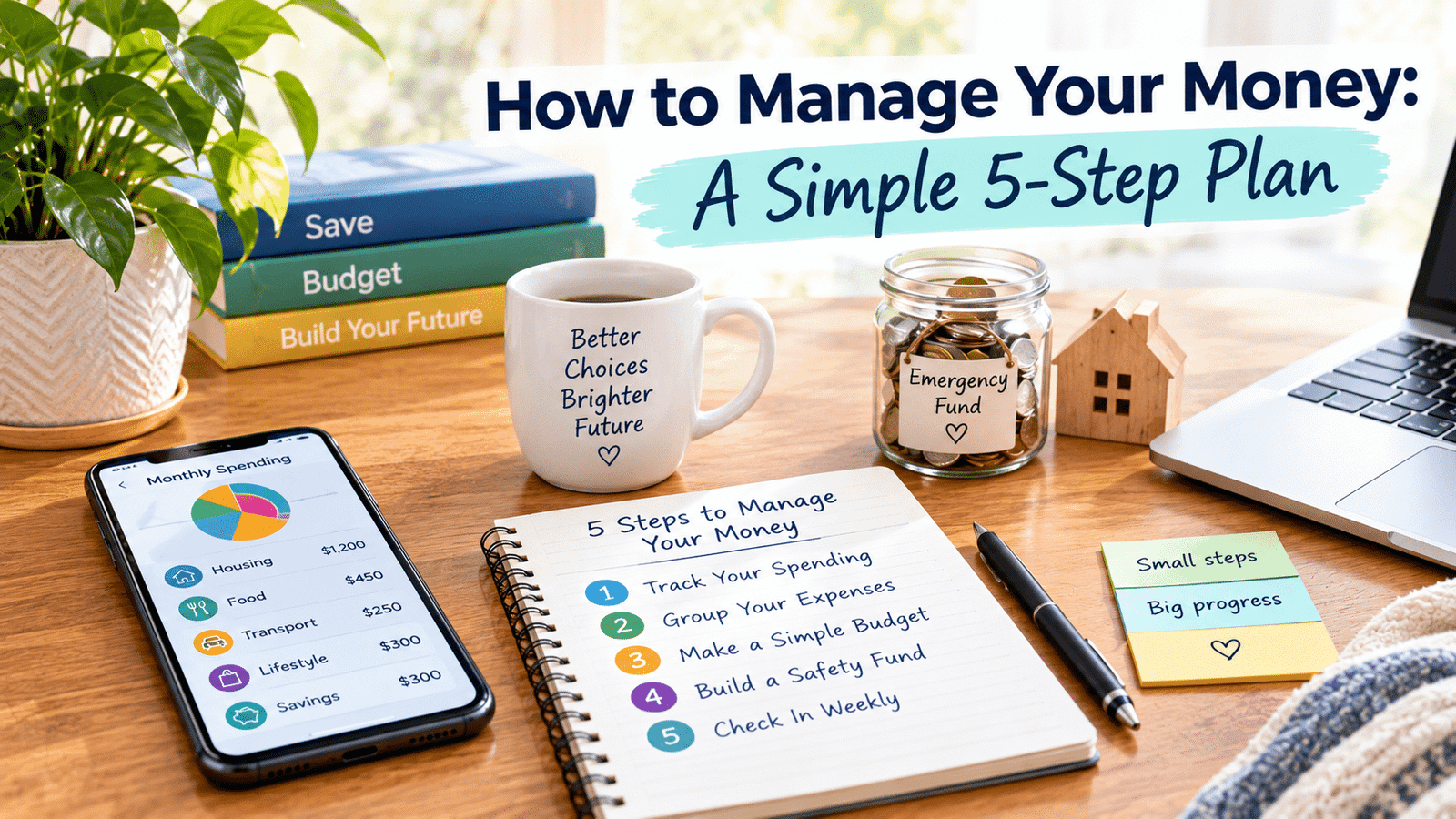
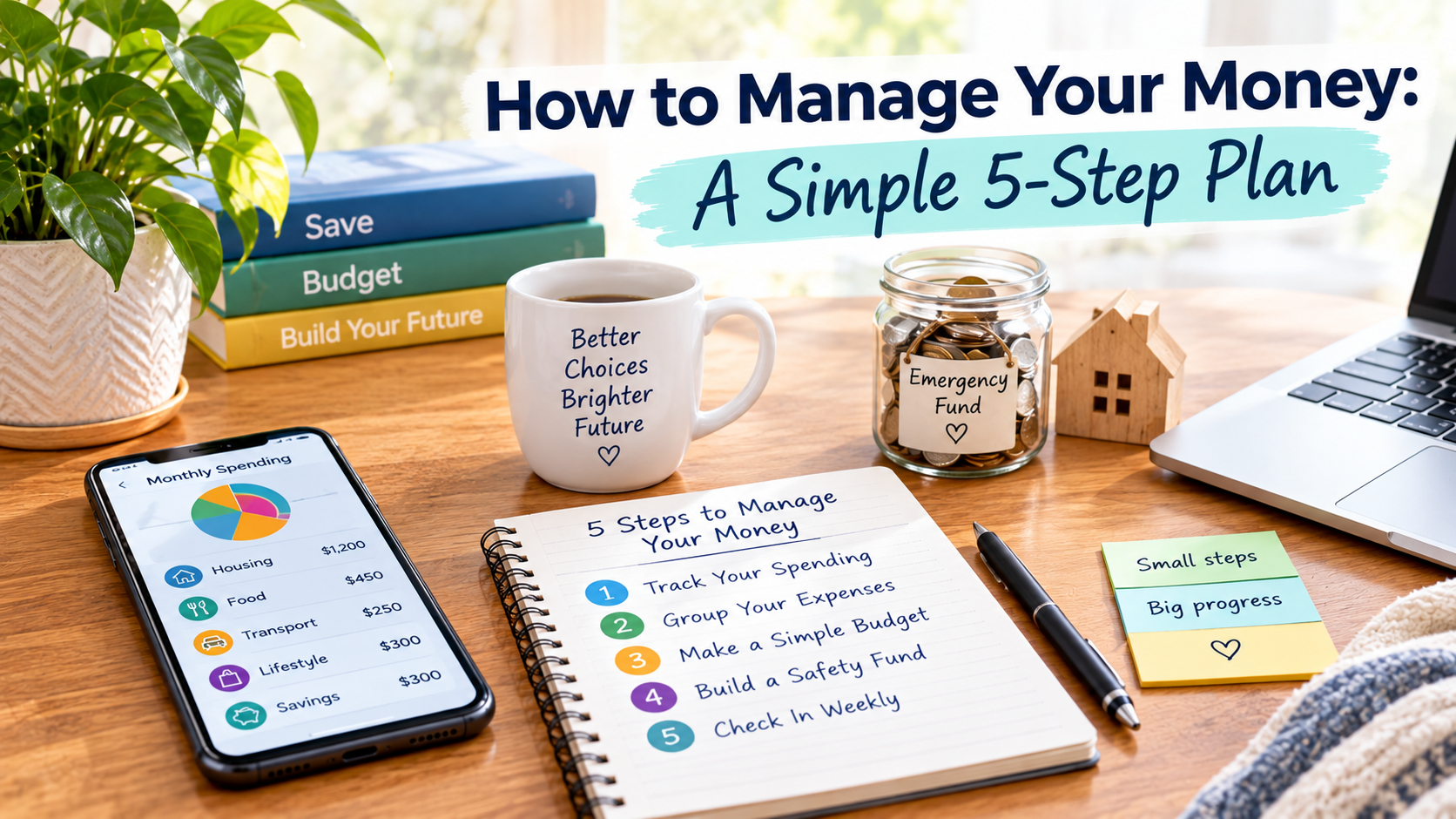
It’s the 20th of the month. You open your bank app, and the balance is lower than you expected. You didn’t buy anything big. So where did it go?
Plenty of people ask that. Few of us were ever taught how to manage your money in plain steps. So here are five. They’re small, and you can start today. I’ll say which facts come from official sources and which are just my opinion.
Why a plan for how to manage your money matters
Rent, food, the phone bill, and a coffee here and there. It all pulls from the same account. With no plan, you lose track fast.
According to the Consumer Financial Protection Bureau (CFPB), the feeling of being in charge of your monthly or daily money matters is one of the main elements of achieving financial well-being.You don’t need to be rich. You just need to feel less in the dark.
Step 1: Find out where the money goes.
You can’t fix what you can’t see, so look first.A CFPB article on managing your spending lists a few tips. Track where all your money goes. Create a budget. Decide how much to spend. Then keep checking where you stand. The article also says getting feedback on your spending can help you keep it in check.
First, retrieve the past month’s statements from the bank and credit cards. List each and every expense down on a sheet of paper or on a computer program. Don’t make any judgments about what you see.It will probably sting a little. It is often the smaller recurring expenses that add up more quickly than the larger ones.
Step 2: Put each expense in a group.
Now sort what you wrote. I use three groups:
- Expenses that must be paid: rent, bills, food, transport, and minimum payments towards debt.
- Desirable expenses: eating out, streaming, hobbies, and shopping.
- Future you: savings and extra debt payments.
That’s my own method, so change it if it doesn’t fit your life. The point is to see how much of the month is already spoken for.
Step 3: Make a plain budget for how to manage your money
A budget is just a plan for your money before the month starts. It’s the middle piece of how to manage your money.
Let’s imagine one. Assume that your monthly earnings are $3,000. You can allocate $1,600 to essential expenses, $700 to discretionary spending, and $700 for savings and debt repayment.Your numbers will look different. Rent alone changes a lot from city to city.
Want more detail? Our guide to the zero-based budgeting method shows how to give every dollar a job.And expect the plan to break sometimes. A car repair shows up, or a birthday.When this occurs, change the figures and proceed. It is better to have an acceptable budget rather than a perfect budget that is abandoned in one week.
Step 4: Start a small safety fund.
A lot of people skip this one. It’s the step that keeps small problems small.The CFPB’s guide to building an emergency fund says that without savings, even a minor financial shock could set you back. It also says people without savings may turn to credit cards or loans, which can mean debt that’s harder to pay off.
So how much should you save? The guide gives no set amount. It says to think about the most common surprise costs you’ve had before. And it says even a small amount can give you some security.
So start small. Ten dollars counts. Here are the guide’s tips:
- Arrange to have an automatic transfer from your checking account to your savings account. According to the guide, this is usually one of the easiest ways to save money.
- If you have such an option from your employer, have a portion of your salary transferred directly to savings.
- Put some or all of a tax refund or cash gift into savings.
- Pick a goal, and check your progress now and then.
My own tip: move the money the day you get paid. If it’s gone from checking, you can’t spend it.
Step 5: Check in once a week
A plan only works if you look at it. This is what turns how to manage your money into a habit.Pick a day. Sunday night works for me. Spend ten minutes on three things. Look at your balance. Compare it to the plan. Fix whatever’s off. Short on time? Five minutes is fine.
The CFPB guide also suggests balance alerts or calendar reminders to help you avoid overdraft fees. A weekly check fits right in.This is where most people win. You spot a charge you forgot. You see you’re ahead on groceries. You catch a mistake while it’s small.
Common mistakes with how to manage your money
- Making the budget too tight. If you leave out all fun money, you’ll quit by Thursday. Leave room for a treat.
- Skipping the safety fund. One surprise bill can undo months of work.
- Tracking for a week, then stopping. The habit helps, not one try.
- Comparing yourself to someone else. Their money life isn’t yours.
- Missing small leaks. Old subscriptions are the classic one. Check your statements for things you don’t use.
What if money is really tight?
Sometimes there just isn’t enough coming in. That’s rough, and no plan can make money from nothing. But the steps for how to manage your money still help. Knowing where you stand allows you to determine what can be cut, even if it is only a little. But even a few dollars per week can make a big difference.If you feel you cannot move forward, seek out a reputable credit counselor or an advisor. I can’t recommend one because each situation is different.
Your next step
Pick one step and do it today. Just one.
I’d start with step one. Open last month’s bank activity and list the top ten places your money went. That’s it. By the end you’ll know more than you did this morning.For more plain guides, browse our budgeting & saving posts. The best way to learn how to manage your money is to start small and stay with it.
FAQ
What is the first step in managing money?
Follow your cash. Write down what you spent last month and categorize it accordingly. You cannot properly plan unless you look at the hard facts.
How much should I save in a safety fund?
The CFPB guide doesn’t set one number. It says to look at the surprise costs you’ve faced before. It does some good to have even a little bit. Begin with whatever you have.
How often do I have to review my budget while learning how to manage your money?
Once a week is sufficient for most people. It takes ten minutes to be able to spot mistakes before they happen. Create a reminder that you won’t forget about it.
Should I use an application?
No. You can just use a notebook or a spreadsheet. It may help only when it’s helping you stay consistent with yourself.