Years of payments, and the balance still looks about the same. If that’s you, or you’re just starting out and already dreading it, take a breath.
There’s no secret hack here. Knowing how to pay off student debt fast mostly comes down to a handful of small habits and the order you do them in. Let’s walk through them.
What does paying off student debt fast mean?
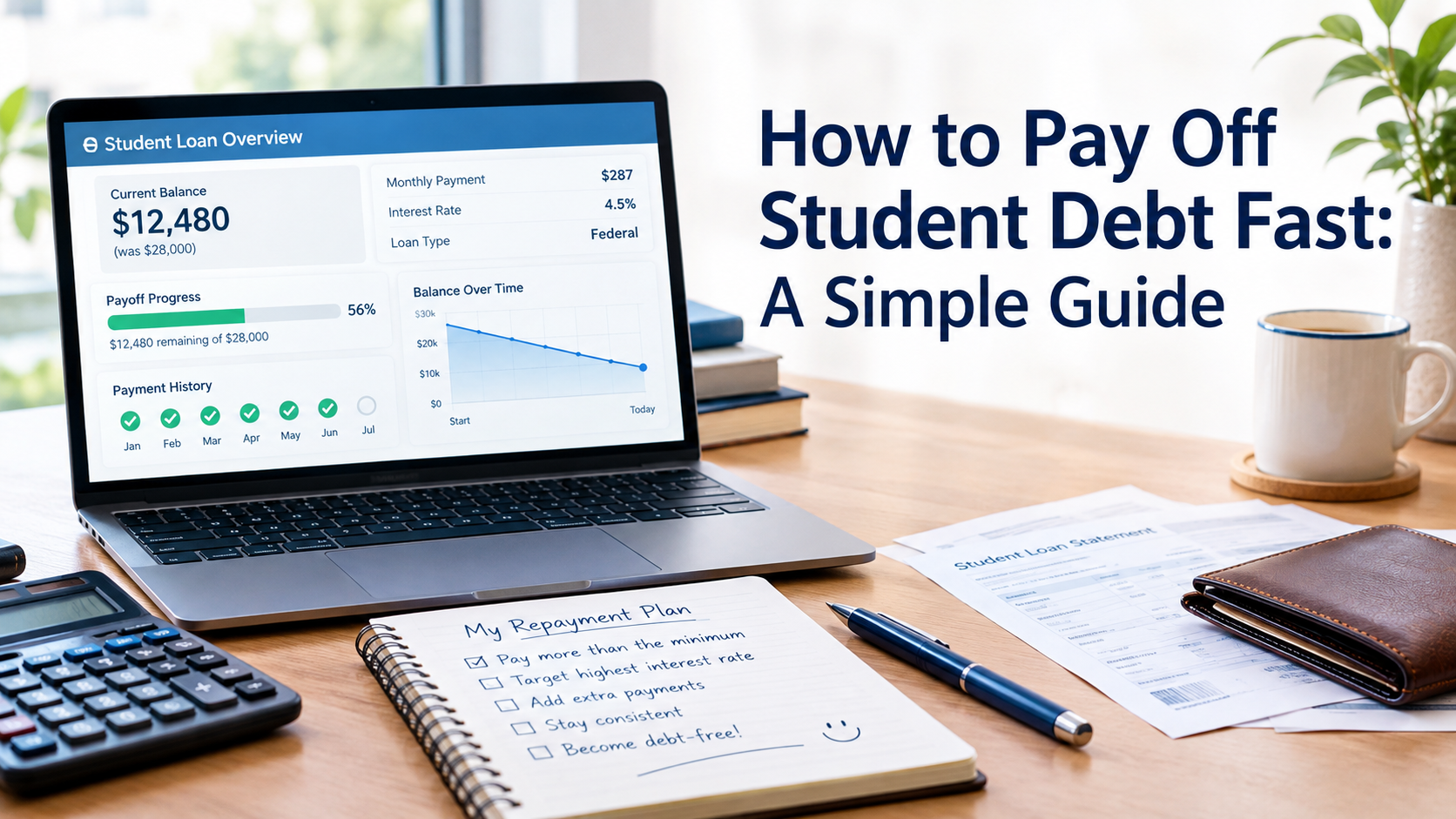
Paying more than the minimum. That’s the whole idea. Your loan ends sooner, and you hand over less interest on the way.
Why does it work? Every payment covers the interest first. Whatever’s left goes to the balance. A smaller balance means less interest next month, so more of your next payment hits the balance. It snowballs, in a good way. That’s why extra money that shows up early does the heaviest lifting.”Fast” is also up to you. Maybe it’s five years. Maybe it’s knocking two years off a long plan. Choose a goal you can keep up. That’s all; how to pay off student debt fast has to mean.
How to pay off student debt fast: start with what you owe.
Open your servicer’s site. Write down every loan with its balance, its interest rate, and its monthly payment. Federal loans all show up on StudentAid.gov, so that’s a good place to check.
Done? Now look at the rates. The loans with the highest ones are the ones to attack first.
How to pay off student debt fast with extra payments
Good news: extra money is your best tool. Federal rules don’t let anyone charge you a penalty for paying early, and private lenders can’t either.
But here’s the catch. You have to tell your servicer what to do with it. If you don’t, extra cash can get spread around, or it can just push your next due date forward. Nice feeling, little savings. So send it straight to the balance, ideally on the loan with the highest rate. Lots of servicers let you set that up online. Or call them.
Then check your next statement. Services have been known to miss instructions, so make sure your money landed where you wanted it.
How to pay off student debt fast: pick a strategy.
Two plans get talked about the most. Avalanche means extra cash goes to your highest-rate loan, and everything else gets the minimum. On paper it’s the cheapest. Snowball means you kill the smallest balance first, then roll that payment into the next one. It costs more, but crossing a loan off the list feels amazing.
So which one? If your rates are all close, take the snowball for the momentum. If one loan is way pricier than the rest, the avalanche will save you real money. Whichever you choose for how to pay off student debt fast, the winner is the one you’re still doing in March.
Know your repayment plan, because the rules changed.
Federal repayment rules have moved a lot, so look before you leap. As of late 2026, NYC’s consumer protection agency walks through the changes in its guide to federal student loan changes.
The SAVE plan is gone. People who were on it started getting notices on July 1, 2026, and have 90 days to choose something new. Don’t pick, and you land on a standard plan, which usually costs more each month. There’s also a new plan called the Repayment Assistance Plan, or RAP, that was set to open by July 1, 2026. Payments start at a $10 monthly minimum and can climb to 10% of income. The guide warns RAP is likely to be the most expensive income-driven plan for many borrowers, and forgiveness only arrives after 30 years. Two older plans, ICR and PAYE, end on July 1, 2028.
What does this mean for how to pay off student debt fast? A tiny monthly payment feels like relief, but it can drag your loan out for years. Fixed-payment plans like Standard usually finish sooner, though each payment is bigger. Short on cash? Keep the smaller payment and toss in extra when you can. Check StudentAid.gov before you switch anything.
Student loan refinancing vs. federal loans
With refinancing, a private lender pays off your old loans and gives you a new one, hopefully at a lower rate. Lower rate, less interest. That makes it one possible answer to how to pay off student debt fast.
There’s a real catch, though. Once your federal loans go private, the federal perks go away. That means income-driven plans and forgiveness. The CFPB’s student loan resources point federal borrowers to the Department of Education and say to use up federal options before taking a private loan. Steady job, strong credit, and no interest in forgiveness? Could be worth a look. If not, I’d leave federal loans where they are.
Find extra money for student loans.
Every bit helps with how to pay off student debt fast. Got a raise or a bonus? Send it to the loan before it vanishes into your daily spending. Round your payment up, so $287 turns into $300. Tax refund coming? Drop it on the balance in one go. And that phone plan you barely use might be worth canceling, with the savings aimed straight at your loan.
Already stretched thin? Our guide on how to pay off debt fast with a low income has ideas that don’t need a bigger paycheck.
Watch out for student loan scams.
Scammers love student debt. Anyone who asks for a fee to lower your payment or erase your loans should make you nervous. NYC’s consumer agency says it plainly: you never have to pay for free federal and state programs, forgiveness included. Go through StudentAid.gov or your servicer. If someone asks for your login, hang up.
Your next step
Pick one thing this week. Make a list of your loans. Or call your servicer and ask how to put extra money on the highest-rate loan. Or just round up a single payment.
Got other debt too? Read our guide on how to pay off credit card debt fast. The principle of paying off student loans quickly remains quite simple: pay a little extra, pay it where it needs to be paid, and continue doing that.
FAQ
Can I pay off my student loans early without a penalty?
Yes. Federal rules don’t allow a penalty for paying early, and private education lenders can’t charge one either. Just make sure your extra payment goes to the balance.
What is the fastest way to pay off student debt?
Pay above the minimum and make additional payments to the loan with the highest interest rate. Refunds, promotions, or other revenue sources could expedite the process.
Should I refinance my federal student loans?
Only if you’re sure you won’t need federal perks like income-driven plans or forgiveness. Refinancing turns federal loans into private ones, and you can’t switch back.
How to pay off student debt fast on a tight budget?
Keep with the smaller payments so that you remain safe, but throw in more whenever possible. Always round off the payments, send in a tax return, and reduce a bill.
Is the SAVE plan still available?
No. NYC’s consumer protection agency says the SAVE plan is no longer available, and borrowers were told to pick a new plan. Check StudentAid.gov for your options.