Picture a woman named Dana. Payday hits on Friday, and by Wednesday her account is nearly empty. She didn’t blow it on anything wild (no trip, no new TV).This information just slipped away from me through groceries, gas, a couple of pizza nights and an increase of eleven dollars in my telephone bill without anyone noticing. The 50/30/20 budgeting plan is meant for those who sit and wonder where all their money goes. This is one of the most simple budgeting plans to follow and I will explain how it works, implement it using a paycheck and how you can do this if your bills won’t fit into it.
What Is the 50/30/20 Budget Rule?
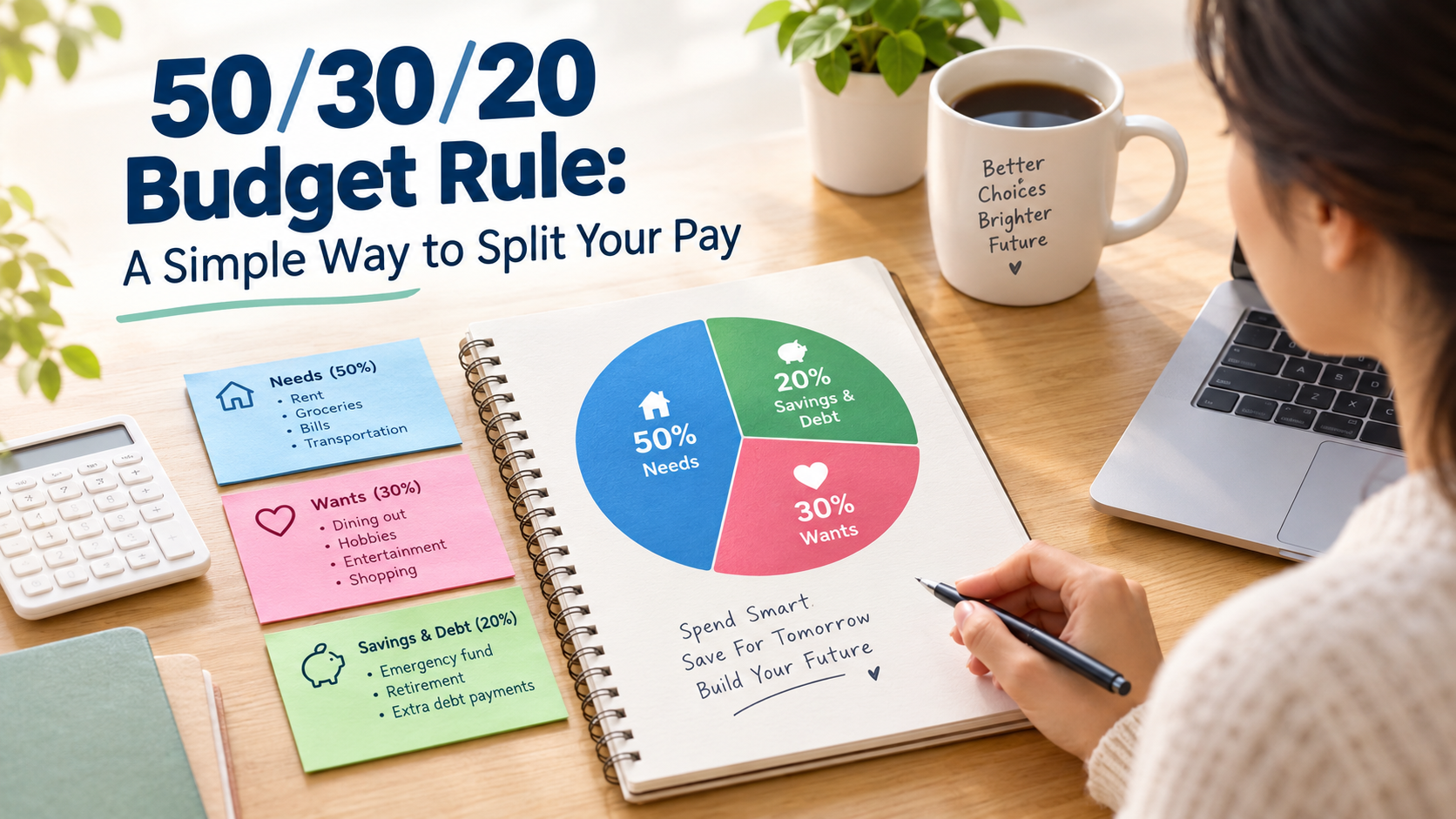
Pretty simple, honestly. You take the pay that actually lands in your bank account, after taxes, and carve it up. Half covers needs. Thirty percent goes to want. Whatever’s left, which is twenty percent, goes to savings and debt. There you have it; it’s the 50/30/20 budget rule, and it could be written down on a little Post-it note. The 50/30/20 rule was invented by Elizabeth Warren (a U.S. senator) and her daughter, Amelia Warren Tyagi. It was explained in their book titled “All Your Worth” published in 2005. What makes the rule so timeless? In my opinion, it’s that there is no need to learn about the rule beforehand.
How the 50/30/20 Budget Rule Works
Needs are those bills that sting when ignored. Rent, food, electricity, auto insurance, gasoline, and at least the minimum payment on any debt or credit card. Skip those, and you lose your apartment, or your credit score takes a hit, so they go first.
Wants are everything you’d miss but wouldn’t die without: takeout, Netflix, new sneakers, and a weekend at the lake. A lot of people feel weird about this bucket. I think it’s the smartest piece. The 50/30/20 budget rule hands wants a full 30% because budgets with no fun in them tend to die around week three, and then you’re back to guessing.
The last 20% is for later. Emergency savings, retirement account, and any extra payments toward debt above the minimum payment. If you can, make that transfer immediately after your payday, before you do something stupid with it.
A Real 50/30/20 Budget Example
Say you bring home $3,000 a month.
- Needs (50%): $1,500
- Wants (30%): $900
- Savings and debt (20%): $600
Now plug in a real life.The cost of rent is $1,000, groceries are about $300, and the telephone, electricity, and automobile insurance add up to $200, which totals $1,500 precisely – which, yes, does not happen, but it simplifies the numbers.You’ve got $900 for eating out, hobbies, and that app you keep paying for and never open. Then $600 goes to savings or debt.
You don’t need a fancy calculator. Take your pay times as 0.5, then times 0.3, then times 0.2.
How to Use the 50/30/20 Rule Step by Step
The first time through, the 50/30/20 budget rule takes maybe twenty minutes. Find your take-home pay on your pay stub. (If your pay jumps around, use your worst recent month so you don’t plan around money that might not show up.) Then open last month’s bank statement and mark what was a true need. People are often surprised here. You might find your needs are 58%, not 50%, and that’s okay. Now you know.
After that, put everything else into wants or savings. Close is good enough. Set up one automatic transfer for your 20%, and look at the whole thing once a month. That’s really all there is to it.
Does the 50/30/20 Rule Work on a Low Income?
Sometimes it doesn’t, and I’d rather say so than pretend. Where rent is high, housing alone can swallow half your check. Take someone clearing $2,400 with $1,300 in rent. They’ve blown the needs limit before buying a single apple.
So bend it. A 60/20/20 or 65/15/20 split is still a budget and still a good one. I’d much rather see someone save 10% on a bent version than give up on the 50/30/20 budget rule because the textbook numbers felt out of reach. Our guide on how to pay off debt fast with low income has more ideas for months when money’s tight.
Needs vs. Wants: Where Do Things Go?
Sorting expenses under the 50/30/20 budget rule is where people end up arguing with themselves. Groceries? Need. A $90 steak dinner? Want. A basic phone plan is a need; the newest model is a want. You need a car to get to work, but the sunroof package, sorry, is a want.
Debt is the odd one because it lands in two spots. The minimum payment is a need, since you owe it either way. Anything extra goes into the 20% bucket. And if you’re carrying a credit card balance, that extra money works hard, because card interest is usually pretty steep. Our post on how to pay off credit card debt fast goes through how to attack it.
Where the 50/30/20 Budget Rule Falls Short
It’s not perfect, and it never claimed to be. Percentages don’t care how much you earn. If you make $150,000, spending 30% on wants is a lot of takeout. If you make $28,000, saving 20% may be close to impossible. Neither of them is doing it wrong. The rule just wasn’t built for them.
Irregular pay is another snag. Freelancers and hourly workers can build the budget around their lowest month, then drop any extra into savings when a good month comes along.It will also be compared to zero-based budgeting, which means that all your dollars will be put to use somewhere. This type of budget is much stricter and takes up more time than the 50/30/20 budget rule. If you have never done budgeting before, try the 50/30/20 budget rule first.
Curious how other households spend? The Bureau of Labor Statistics posts its Consumer Expenditure Surveys for free. And the Consumer Financial Protection Bureau has free money tools if you want a worksheet to start with.
Your Next Step
Tonight, pull up last month’s bank statement. Find out your net pay and then multiply it by 0.5, 0.3, and 0.2 and see how much you are off. Do not worry too much if it is a lot. Alter one factor at a time. Once you have done all of the above, then start setting up the first automated deposit from your payday.
FAQ
What is the 50/30/20 rule in simple terms?
Your salary is divided into three equal parts after you’ve deducted taxes. Fifty percent goes towards your needs, thirty percent goes towards your wants, and twenty percent towards savings and additional debt repayment.
Is the 50/30/20 budget rule based on gross or net income?
Net income, also called take-home pay. That’s what you get after taxes come out. Using your pre-tax pay would make every bucket too big.
Do debt payments count in the 50/30/20 rule?
Yes, in two places under the 50/30/20 budget rule. The minimum payment counts as a need. Any extra payment counts toward your 20% savings and debt bucket.
What if my needs are more than 50%?
Modify the split to better suit your lifestyle, whether that is 60/20/20 or 65/15/20 and always save something from your income. Slowly reduce your large expenses such as rent and transportation costs.