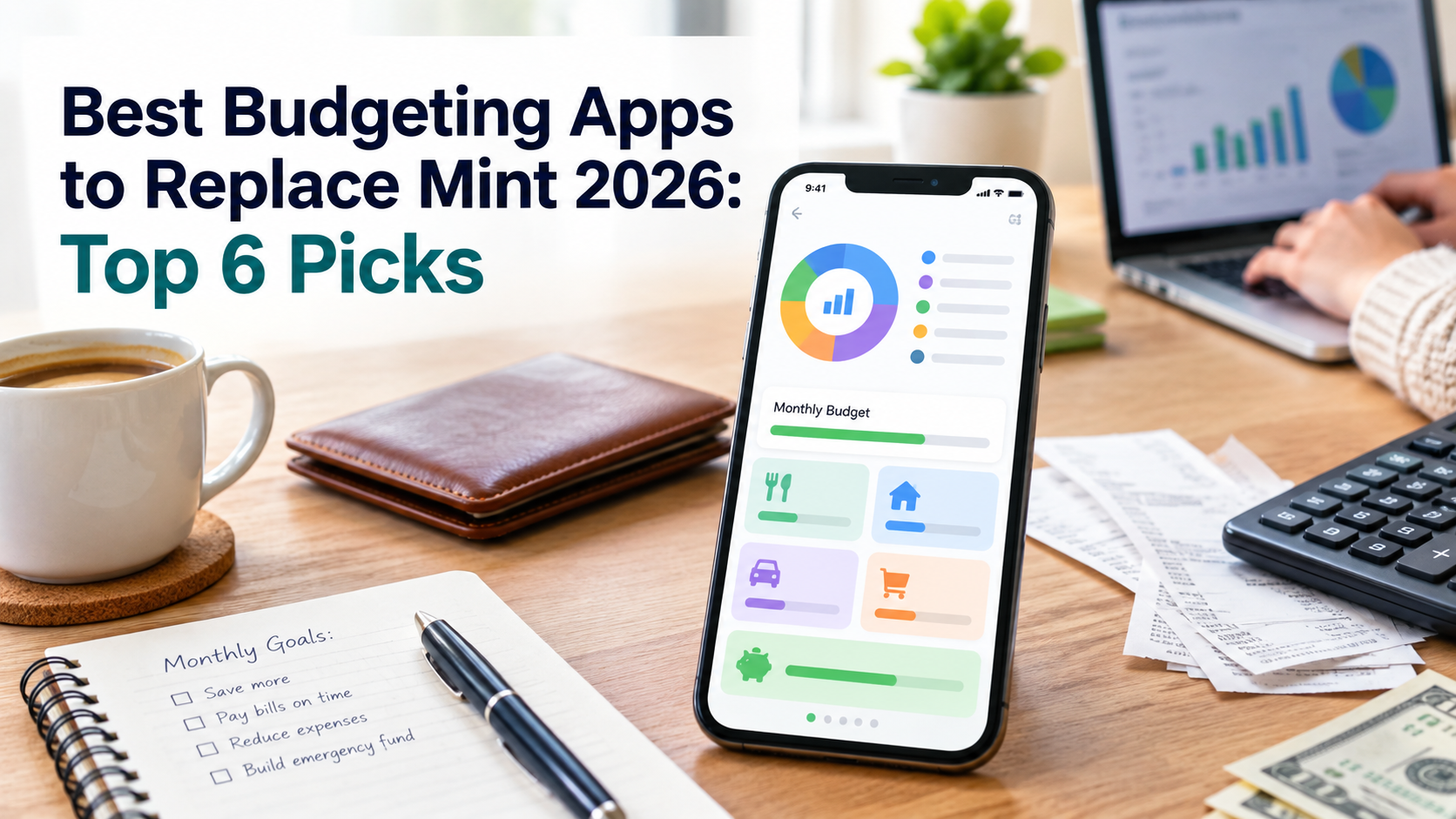
Sunday morning. Coffee. You open Mint, wince at the restaurant total, and close it again. That was the whole routine, and for a lot of people it worked. Then Intuit pulled the plug on March 23, 2024, and Pointe2026, at Credit Karma, which is fine for staring at a credit score and not much help for a budget. Two and a half years later, people still ask what to use instead. So here are the best budgeting apps to replace Mint 2026, with real prices and no hype. Why the best budgeting apps to replace Mint 2026 mostly cost money Mint was free, and that was the problem. Ads and referral deals paid the bills, and at some point Intuit decided that wasn’t worth it. So the apps that came after mostly charge you directly. I know, it’s annoying. But that’s how I read it: when you pay, you’re the customer instead of the sales lead. The best budgeting alternatives for replacing Mint in 2026 can be categorized into four types: similar to Mint, free, easy-to-use for beginners, and couple-friendly. Figure out your use of Mint (dashboard feature? Bill alerts? just plain old curiosity?), and the category will come clear. The government’s own advice is oddly low-tech. This is according to the CFPB, which states that the tracking method should be real-time manageable and should be considered each month individually. You can read it in its guide to budgeting and sticking with it. Mint alternatives that feel closest to the old app To find the nearest alternative, Monarch Money should be considered. Plan it, multiply it and name it the nearest alternative as the dashboard features will seem familiar: bank connections, expenditures, net worth, and goals. However, the problem lies in the cost. It will cost $14.99 monthly or $99.99 yearly with a seven-day trial period only.Seven! Barely enough to link your accounts and get distracted. YNAB is a whole other animal. Mint showed you the damage after you spent the money. With YNAB, you get to choose how you will use your money, similar to justifying why you need the burrito prior to purchasing it. In case you go overboard, then that is precisely what YNAB intends to achieve. It costs $14.99 per month or $109 per year. Prices drift, so check each app’s own site before you pay. Free budgeting apps (and what you give up) It’s free but you will miss something. Goodbudget is basically an envelope budgeting system which is an old school way of budgeting where you split your income into categories of expenses and enter them manually. There’s a limited free plan. PocketGuard’s free tier gives you one simple number: what’s safe to spend. Honey, due costs nothing. Rocket Money’s basic plan is free too, and it’s good at sniffing out subscriptions you forgot about (we all have one). Empower is free as well, though it cares more about your investments than your grocery budget. Credit Karma is free and was Intuit’s own suggestion, but it doesn’t have Mint’s budgeting tools. Use it for credit, not for planning your month. Nobody gets all of Mint for free anymore. So ask which part you actually used. Any list of the best budgeting apps to replace Mint 2026 that says everything is free is skipping a step. Want more guides like this? Our best budgeting apps to replace Mint 2026 coverage live on FinanceCash. Budgeting apps for beginners: start boring. New to this? If you’re just beginning, the best budgeting apps to replace Mint 2026 are the ones you can set up before your coffee gets cold, about ten minutes. Goodbudget and PocketGuard fit that, and you can try both for free. YNAB can work too, but you’ll have to learn how it thinks, and the long trial is your chance to see if that clicks. Link one account. Just one. Say rent hits on the 1st and car insurance on the 15th: Put those two dates first, because they explain most of that mid-month money panic. Then check in once a week, same day, five minutes tops. Best budgeting app for couples: who sees what Sharing money is where budgeting apps get awkward. Monarch lets a partner share household access, so you’re both looking at the same numbers. Honeydue is free and was made with couples in mind. YNAB works for two people too, but only if you both buy in. When you test the best budgeting apps to replace Mint 2026 as a pair, test the sharing first. One cheap trick: pick a day, open the app together, and give it fifteen minutes. Way better than arguing about a credit card bill in the car. Personal finance apps: how to choose without losing a weekend Alright, how do you pick? The best budgeting apps to replace Mint 2026 will depend on what you use Mint for, how much you can afford to spend per month, and whether or not you will ever even open it up. The latter is most important. Give the app two weeks before you decide. It also helps to have a plan before you download anything. California’s DFPI has a 6-step financial plan for 2026 that walks through a realistic budget, including the 50/30/20 idea.And one thing nobody enjoys hearing: your old Mint history isn’t coming back. You’re starting fresh. Annoying, sure, but it’s also a shot at categories that fit your life now. Mistakes to avoid with the best budgeting apps to replace Mint 2026 People make the same mistakes every time. They prepay for a full year before testing. They pick the app with the most features, connect every account at once, and feel buried by day two. Or one bank sync fails and they quit, even though connections break sometimes and a reconnect often fixes it. Some give up in week two because the numbers look scary. (The numbers were there before the app.) Go slow, test free, and give it a month. If it doesn’t
Credit Score Myths That Are Costing You Points
There is one lady named Carla who was planning to take a car loan after checking her credit score. But her cousin convinced her that there was no need to do that because if she checks her credit score herself, it will reduce the score. She did not consider his advice and applied for the loan without doing any checks, and as a result, she had to pay a higher rate of interest for her loan. That single piece of bad advice cost her real money. It’s one of dozens of credit score myths floating around, passed from friend to friend like it’s fact. Some of these myths are harmless. Others quietly wreck people’s finances for years. Myth: Checking Your Own Score Hurts It This is probably the most common of all the credit score myths, and it’s just not true. Checking your own score is called a soft inquiry. It doesn’t affect your score at all, no matter how many times a day you look. People go years avoiding their own credit report because of this one myth alone. What actually lowers your score a little is a hard inquiry, the kind that happens when a lender checks your credit because you applied for a loan or a new card. Even then, the drop is small and temporary. The Consumer Financial Protection Bureau confirms that pulling your own free credit report never affects your score in any way. Check it as often as you want. Myth: Closing a Credit Card Helps Your Score Closing a card you’re not using sounds responsible. It usually backfires instead, and here’s why. Closing a credit card hurts your credit score in two specific ways. It lowers your total available credit, which raises your credit utilization ratio, the percentage of credit you’re actually using. It can also shorten the average age of your credit history if the card is an old one. For example, assume that you own three credit cards worth $15,000 in total and owe a balance of $2,000. This is a low utilization rate of 13%, which is good for your credit score. Close the card with the $8,000 limit, and your ratio jumps to over 28% on the same balance, even though you didn’t spend a dime more. That jump alone can drop a good score by 20 points or more, depending on the rest of your credit file. Myth: Carrying a Balance Builds Credit Here’s one that quietly costs people real interest money for nothing. The myth of carrying a balance will improve your credit score revolves around keeping a small unpaid balance on your account to show the lender that you are a good borrower. This is simply not true. No one knows where this originated from, but it just won’t die. Your credit score is affected by whether or not you are making timely payments and how close you are to maxing out your account.Paying your statement in full every month is better for your score and your wallet. Experian states plainly that carrying a balance provides no credit score benefit and simply costs you money in interest. Myth: You Only Have One Credit Score People expect one single, official number. Nope. You have several credit scores, which are computed based on various models such as FICO and VantageScore, and are obtained from the three main bureaus that are Equifax, Experian, and TransUnion. That’s why the score a lender pulls during a mortgage application can land 40 points away from the one you saw on a free app last week. Both numbers can be accurate at the same time. Myth: Your Income Affects Your Credit Score A lot of people assume a bigger paycheck means a bigger score. Nope. Income isn’t part of the calculation at all. Someone earning $200,000 a year with missed payments and maxed out cards can end up with a lower score than someone earning $40,000 who just pays on time, which throws people off since it seems backwards. Lenders do look at income separately when deciding whether to approve a loan, but the score itself only reflects how you’ve handled credit, not how much you make. Myth: Getting Married Merges Your Credit Scores Newlyweds sometimes worry a spouse’s bad credit history will drag their own score down the moment they say “I do.” Take a breath; it won’t. Credit scores stay individual for life, marriage or not. There’s no joint score that averages the two of you together, no matter how much your finances merge in every other way. What can change is your credit if you open joint accounts together, like a shared credit card or a mortgage. Once both names are on an account, that account’s payment history shows up on both credit reports. So a spouse’s late payment on a joint card can hurt your score, but their old, pre-marriage credit history never touches your report at all. What Actually Improves Your Credit Score Since the myths get so much attention, it helps to end with what genuinely works.Timely payment of all bills has been the largest contributing component accounting for about 35% of the total FICO score. The second largest contributor to one’s score is the maintenance of your credit utilization ratio under 30%, preferably 10%.Together, those two habits alone account for nearly two thirds of the score. Beyond that, how to improve your credit score usually comes down to patience more than tricks. Avoid opening several new accounts at once. Let old accounts stay open when you can. Check your credit reports for errors through AnnualCreditReport.com and dispute anything that looks wrong, since mistakes on a credit report are more common than most people realize. Why These Credit Score Myths Are So Hard to Kill Most of these myths stick around because they sound reasonable. Closing a card feels responsible. Carrying a balance feels like proof of trustworthiness. Sorting credit score facts vs myths usually just takes checking the math instead of trusting your gut, but

Passive Income Ideas for Beginners: 7 Ways to Start This Year
Sarah works 40 hours a week at a call center in Dayton, Ohio. Her paycheck covers rent, groceries, and her car payment. By the third week of the month there’s nothing left. She didn’t want a second job stacked on top of the first one. What she wanted was money showing up without handing over more of her time. That’s basically what sends most people looking into passive income ideas for beginners. Not some secret trick, because there isn’t one. Just a short list of options that actually work if you pick one and don’t quit after two weeks. What Passive Income Actually Means “Passive” is doing a lot of lifting in that phrase, honestly. It’s money that keeps showing up after the setup work is done, sure. But almost nothing here is truly hands-off, at least not at first. A few of these take real hours. One or two take real cash. The payoff shows up later, once whatever you built is running without you standing over it. Here are seven, starting with the one that takes the least work and building up from there. 1. Open a High-Yield Savings Account Start here if you want proof before you risk anything real. A regular savings account at a big bank pays something like 0.01% a year, which rounds down to nothing. Online banks offering high-yield accounts pay a lot more than that. Drop $2,000 in one and you’ll actually see interest land every month. No spreadsheets, no guessing. Nobody’s retiring off this. But if you’re starting from passive income ideas with no money to spare for risk, this is about as safe as it gets. The FDIC covers deposits up to $250,000 per bank, so the money just sits there earning while you sleep. 2. Buy Dividend Stocks or a Simple Index Fund Other firms pay their stockholders some part of the earnings quarterly, in what is termed a dividend. If you have a few stocks from a company such as Coca-Cola or Johnson & Johnson, they will pay you to own those stocks. Feels a little like cheating the first time it hits your account. You don’t need much to get in. Fractional shares run $10 or $20 through most brokers now. If picking individual companies sounds like a headache, a dividend index fund does the spreading for you across hundreds of stocks at once. Worth ten minutes on the U.S. Securities and Exchange Commission’s investor education site before any money moves. 3. Sell a Simple Digital Product Know how to do something well? Budgeting, meal planning, and basic design don’t matter what. Package it. A budget spreadsheet, a resume template, and a short PDF guide—these sell for $5 to $30 on Etsy or Gumroad, and people buy them more than you’d expect. Build it once, and it keeps selling while you’re asleep, at your day job, wherever. Of everything on this list, this one costs the least to start. Basically just your time and maybe a free afternoon. 4. Rent Out What You Already Own Walk through your own house for a second. A spare bedroom sitting empty most nights. A driveway nobody uses after 8am. A power drill that comes out twice a year, tops. There’s an app for renting out almost all of it now. Parking spots in cities like Chicago bring in $100 to $200 per month by simply being.While it does not require any active work, someone needs to respond to emails and bookings.But next to picking up a second job, the time it eats is small. 5. Start a Small Blog or YouTube Channel With Affiliate Links This one’s a slow burn, so don’t go in expecting fast money because you won’t get it. Pick something you actually know, home cooking, car repair, whatever and start posting. Once there’s an audience, affiliate links to stuff you already recommend start paying a commission every time someone buys through them. Six months to a year before this pays anything real, and that’s if it works at all. What makes the wait worth it is that old posts keep earning long after you stop thinking about them. Our team goes deeper on passive income ideas for beginners over on financecash. info, including which tools are worth paying for when you’re starting from zero. 6. Try Peer-to-Peer Lending P2P lending allows you to loan money to individuals or small businesses directly and earn some interest on the loans. You can split up $500 between ten borrowers rather than lending the full amount to a single borrower. Returns can beat a savings account by a lot, sometimes 5% to 8% a year. The catch is real risk. People default. Only put in what you could lose without it messing up your month. 7. Buy a Certificate of Deposit (CD) A CD is for anyone who wants to know exactly what they’re getting before handing over a dollar. Give a bank your money for a set term, a year’s common, and they lock in a fixed rate for you. Pull it out early, and there’s a penalty, but you know your return from day one instead of crossing your fingers. Common Mistakes Beginners Make Quitting too early tops the list. People put in $50, wait three weeks, get annoyed it didn’t replace their paycheck. It was never going to, not that fast. Most passive income ideas for beginners behave more like a garden than a slot machine. Nothing grows until it’s been watered for a while, and that’s just how it works. Second mistake, trying all seven of these at once. That usually means doing all seven badly. Pick one. Get it actually working. Then, and only then, add a second one. Start With One Idea Today None of this means quitting your job or going into debt. Look at what you’ve actually got this week, time or cash, and match it to one idea from this list. Fifty bucks and an hour gets a high-yield savings

Investing for Beginners USA: Where to Actually Start
Jordan is 27, works in marketing outside Phoenix, and has $1,200 sitting in a savings account earning next to nothing. For two years he kept meaning to “start investing” and kept not doing it. Not because he’s lazy. Every article he opened jumped straight into expense ratios and asset allocation without ever answering the actual question: where do I click first? That’s the gap I want to close here. This is investing for beginners in the USA for someone who has a job, some money, and zero interest in reading a finance textbook to get started. What Investing Actually Means Investment is defined as an investment of funds in some assets that have the potential to increase in value in the future; these include securities and bonds. Investment is not synonymous with the savings accounts, which are safe but fail to keep up with inflation in these times.What you put in can lose value before it gains any. Anyone who tells you otherwise is selling something. The SEC’s own investor education office frames it plainly: you’re putting money into an asset expecting a return over time, and that return comes either from the asset’s price going up or from dividends and interest along the way, per investor.gov‘s introduction to investing. Best Investment Accounts for Beginners You need somewhere to hold the money before you can buy anything, so let’s get through this part fast.A taxable brokerage account is the most flexible option on the list. No income limits, no penalty for pulling money out whenever you want. You’ll owe taxes on gains and dividends each year, which is the trade-off for that flexibility. Fine for general goals that aren’t specifically retirement. The money used to fund the Roth IRA has been taxed previously. However, the benefit comes when you withdraw from the account in your retirement, and everything is tax-free.There are income limits on who can contribute directly, so it’s worth checking those before you assume this is your account. A traditional IRA runs the opposite direction. You might get a tax deduction now, but withdrawals get taxed later in retirement. Makes more sense if you expect a lower tax bracket down the road than you’re in right now. A 401(k) through your employer deserves a mention even though you don’t open it yourself. If your company matches contributions at all, that’s free money sitting on the table. A typical structure is 50 cents on the dollar up to 6% of your salary, which is basically a guaranteed 3% raise for showing up and contributing. Grab that match before you send money anywhere else. The IRS page on traditional and Roth IRAs has the actual contribution limits and rules, without the upsell you’ll get on most brokerage sites. Roth IRA vs. 401k for Beginners It’s a common question, but here is a straightforward answer rather than “it depends.” Take the 401(k) match if your employer offers one first. This is a surefire gain that you won’t be able to find anywhere else. After the match, a Roth IRA is usually the better next stop. It gives you more control over what you’re invested in, and you can generally pull out your original contributions early without penalty if life goes sideways, which a 401(k) doesn’t let you do as easily. Once you’ve put in what makes sense there for the year, going back and increasing your 401(k) contribution beyond the match makes sense too. It’s not really either/or long-term. It’s more of an order of operations. Match, then Roth IRA, then back to the 401(k). What About Robo-Advisors? Worth a quick detour here because this is where a lot of beginners actually land. Robo-advisors are automatic tools that will create an investment portfolio for you according to a brief survey you fill out concerning your goals and risk tolerance.You deposit money; it handles the rest, rebalancing included. They’re not free, usually somewhere around 0.25% a year. That’s more than the cost of a plain index fund but less than hiring an actual human advisor. If you genuinely don’t want to pick funds yourself or think about rebalancing, it’s a reasonable middle ground. Just know you’re paying a little extra for someone else to do the thinking, and it’s worth weighing that against just picking one or two index funds on your own. Which Brokerage Should You Actually Pick? That’s the part where everyone stops dead in their tracks, looking at ten different apps, trying to figure out whether it even makes a difference what they choose. For the most part, it doesn’t make as big a difference as you might think. Fidelity, Vanguard, Schwab, as well as a couple of younger apps, all offer accounts without a minimum balance or an annual fee that give you access to low-cost index funds. Vanguard pioneered the concept of the low-cost index fund and continues to run some of the cheapest ones around, even if the app itself is a bit outdated. Fidelity has a smoother interface and throws in a few of its own zero-expense-ratio index funds, which is genuinely rare. Schwab sits somewhere in between: a decent app, a decent fund lineup, and solid customer service if you ever need to call someone. The newer apps that target younger investors usually have better interfaces, but sometimes they might convince you to invest in stocks in parts rather than in dull and stable index funds, as it is more exciting to show interesting stock picks. Nothing is wrong about using an app like this, but you should realize when the interface of the app influences your decision. Jordan chose Fidelity just because his coworker was using it, and he could explain everything to Jordan during lunch time.That’s a perfectly good reason. The best brokerage is the one you’ll actually open and use consistently, not the one with the best reviews on some comparison site. Index Funds for Beginners USA You’ll hear “index fund” thrown around a lot, and it earns the hype.
Debt Consolidation vs. Balance Transfer: Which One Actually Fits Your Debt?
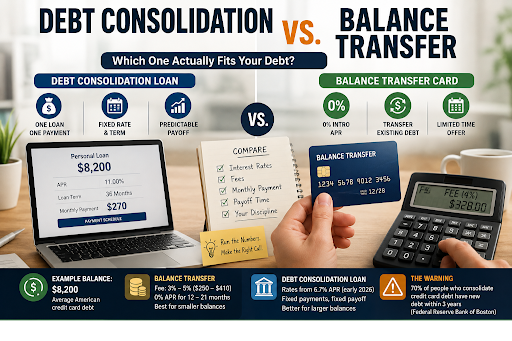
Marcus carries three credit cards and has roughly $8,200 in debt among them, putting him right at the average American credit card debt level for today. Marcus makes some payments on each card every month but doesn’t think he’s getting anywhere. His friend suggested that he should get a balance transfer card, while his colleague said that Marcus should look into getting a debt consolidation loan instead. Neither of them explained themselves further, and Marcus got even more confused. This is a regular situation. Let’s get it straight then. Here’s debt consolidation vs. balance transfer simplified with numbers and facts. What Each One Actually Is In a balance transfer, the money owed on your credit cards is transferred to one new credit card, which may have a low-interest rate or 0% interest for a period of time. It is the same kind of credit card but only the interest rate varies. In contrast, a debt consolidation loan involves borrowing a lump sum from a financial institution and using that money to settle your debts, including credit card debts. After this, you will be repaying one lender instead of repaying three. The objective behind both these loans is the same. They just get there in different ways. The Real Math on a Balance Transfer Say Marcus moves his $8,200 to a card with a 0% intro rate for 18 months. Most balance transfer cards charge a fee upfront, usually 3% to 5% of what you move. On $8,200, that’s roughly $250 to $410 added right away. If Marcus pays around $460 a month, he clears the balance before the 0% rate ends and pays almost nothing in interest. That’s the best case. The catch: if he doesn’t finish in time, the rate jumps back up, often above 20%, and whatever’s left starts collecting interest fast. Miss a payment, and some issuers end the 0% rate early too. The Real Math on a Debt Consolidation Loan A personal loan works differently. As of early 2026, the best rates for well-qualified borrowers start around 6.7% APR, though your rate depends on your credit score. Say Marcus qualifies at 11% APR over three years. His fixed payment lands around $270 a month, and he knows exactly when he’ll be done, with no countdown clock on a promo rate. The tradeoff: he’s paying interest the whole time, unlike a 0% card. But that rate is locked in, and there’s no cliff waiting at month 19 if life gets in the way. When Each One Makes More Sense A balance transfer works best when your debt is small enough to realistically pay off during the promo window, and your credit score qualifies you for a good offer. If Marcus could pay $460 a month and finish in 18 months, that route saves more, fee included. It’s a weaker fit for larger balances, since promo periods run 12 to 21 months, and paying off a big number that fast takes payments most budgets don’t have room for. A loan tends to fit better for bigger balances or anyone who knows they need more than a year and a half to get debt-free. The fixed rate also helps people who’ve struggled with the discipline a 0% window demands, since there’s no ticking clock punishing a slow month. Origination fees exist here too, usually 1% to 8% of the loan, so check the total cost, not just the monthly payment. The Warning Both Options Share Here’s something worth sitting with.According to research conducted by the Federal Reserve Bank of Boston, about 70% of consumers who consolidated their credit card debts ended up having new credit card debts in less than three years. Debt consolidation will not help solve the problems that caused the accumulation of debt. If the old cards stay open and active after you move the balance, it’s easy to end up with both the new payment and a fresh pile of card debt. Whichever route you pick, closing or freezing the old cards, or at least setting a hard rule not to use them, matters as much as the interest rate does. The CFPB’s guide on consolidating credit card debt breaks down the fine print on both options in plain language, worth a read before signing anything. Watch for Debt Relief Scams Legitimate debt relief never asks for payment before doing anything, never calls out of the blue promising a “new government program,” and never guarantees a specific result. If an offer does any of those, treat it as a red flag, per FTC guidance. What Marcus Did He ran the numbers on both. His balance was manageable enough, and his credit was strong enough that the balance transfer route saved him more, as long as he stuck to the plan. He set up automatic payments so he wouldn’t miss the 18-month window, and he cut up (not closed) his old cards so he wouldn’t be tempted to use them. FinanceCash has a free calculator that runs this same comparison with your own numbers, showing the true cost of each option side by side instead of guessing which one sounds better. The Bottom Line Debt consolidation vs. balance transfer isn’t about which one is universally better. It’s about your balance size, your credit score, and whether you can realistically pay it off before a promo rate expires. Run your actual numbers before deciding, and whichever you pick, deal with the spending habits underneath the debt too, or you’ll likely be right back here in a few years. FinanceCash also has a free debt payoff tracker to keep you on pace once you’ve made your choice and a budget planner to make sure the old cards don’t creep back up while you pay down the new one. Frequently Asked Questions Is a balance transfer or debt consolidation loan better for credit card debt? It depends on your balance size and credit score. Balance transfers tend to save more on smaller debts you can pay off within

High Yield Savings Account 2026: Best Rates to Know
Say you have $10,000 sitting in a regular bank savings account right now. At the national average rate of about 0.38%, that money earns you around $38 a year. Not even enough for a nice dinner out. Move that same $10,000 into a high-yield savings account 2026 offers, though, and you could earn ten times as much. Maybe more. Without touching your risk level at all. That gap is the whole reason so many people are moving their cash this year. Rates have held fairly steady through 2026, the Fed hasn’t budged its target much in months, and banks are still fighting hard for deposits. That fight works in your favor if you actually bother to shop around. Best High-Yield Savings Account: What to Look For Honestly, the best high-yield savings account for you probably isn’t the one at the top of some rate chart. It’s the one that fits how you actually use money. So before you get seduced by a big APY number, look past it. Check whether there’s a monthly fee hiding in the terms. Check the minimum opening deposit. Make sure the bank is FDIC insured, which we’ll get into shortly. And think about how easily you can move money between this account and your everyday checking, because a great rate does you no good if transfers take five business days every time. A high-yield savings account with a 2026 that seems fantastic on an apples-to-apples chart doesn’t amount to very much when the bank hides it behind some large minimum balance or makes you pay $15 monthly just to keep the account. You have to read the small print. It’s a drag.Do it anyway. High Yield Savings Account Rates Right Now Right now, high-yield savings account rates mostly land between 3.5% and 4.5% APY at the strongest online banks. That’s according to recent rate roundups from the major financial outlets that track this stuff weekly. Compare that to the 0.38% national average the FDIC reports, and it’s not really a contest. These rates move, though. They’re tied to what the Federal Reserve does with its own target rate, and when the Fed holds steady, like it mostly has through 2026, savings rates hold steady too. Cut, and banks trim their APYs within a few weeks, sometimes faster. None of that means your money is suddenly unsafe. It just means the return breathes with the economy around it, the same way it always has. HYSA vs. Traditional Savings Account A HYSA vs. traditional savings account comparison really comes down to one number, and it’s not close. Traditional accounts at the big brick and mortar banks often pay next to nothing, sometimes literally 0.01%. I’ve seen statements where the interest earned rounds down to a penny. High-yield accounts, mostly run by online banks, pay far more, mainly because those banks aren’t paying rent on a hundred branch locations. Past the rate, the two accounts behave almost identically. Your money stays liquid. You can move it whenever you want, though nearly every savings account, high yield or not, caps you around six withdrawals a month. The real tradeoff with an online-only HYSA is that you can’t walk into a branch and hand someone cash. Everything routes through an app or a website, which some people love and others still can’t get used to. Is My Money Safe? FDIC-Insured Savings Account Basics Before you open anything, confirm it’s an FDIC-insured savings account. I don’t think it’s negotiable, man. In case the bank fails, your deposits are covered up to $250,000 per depositor, per bank, per ownership category by FDIC insurance. There’s no reason to check a bank’s FDIC status directly on the FDIC’s BankFind tool, which takes about half a minute. Nearly every reputable online bank chasing high rates in 2026 is FDIC insured, because without it, nobody would trust them with a dime. If a bank can’t clearly show you its FDIC certificate number, that’s your cue to close the tab and look somewhere else. How Does APY Work? So how does APY work, really? APY is the annual percentage yield, which is the total amount of money you earn in a year, including compound interest. Compound interest is simply interest on interest, as well as on the initial investment. Little difference, big difference over time. Here’s an example. If you invest $5,000 at 4.00% APY compounded daily, you will have approximately $5,204 after 1 year. Past picking the right account, that additional $204 appeared. The larger the APY, the more frequently it compounds, the faster the number grows. Prefer to handle your own calculations rather than my’s?There’s a free savings calculator from the Consumer Financial Protection Bureau that does the math for you. Best Online Savings Account 2026: How to Choose Picking the best online savings account 2026 has to offer isn’t really about the rate chart at all. It’s about matching the account to what you’re actually trying to do. Building an emergency fund? Prioritize easy access and zero withdrawal penalties over an extra tenth of a percent. Saving toward something further out, like a house down payment two years from now? That’s when it’s worth comparing a HYSA against a CD, which locks in a fixed rate for a set term and won’t budge even if the Fed does. Whatever you land on, don’t pick an account just because it topped a comparison chart somewhere. Check the fee schedule. Check the minimum balance rules. Check how fast you can actually get your money out when you need it, not just how fast the marketing page says you can. A high yield savings account 2026 pick that fits your real habits beats one that only wins on paper. Frequently Asked Questions What is a good APY for a high-yield savings account in 2026? Somewhere between 3.5% and 4.5% right now. Anything at or above 4% counts as strong for an account that’s fully liquid and FDIC insured. Can I lose money in a high-yield savings

Personal Loan vs. Credit Card Debt: Which Wins?
Jake owed about $9,000 across three credit cards. Every month he paid the minimum on each one. Every month the balance barely moved. A friend told him to look into a personal loan. Another friend said, “Just move it all to a card with a lower rate.” Jake had no idea which one was smart and which one was a trap. That’s the exact spot most people land in when they start comparing personal loan vs. credit card debt. Both can help you pay off what you owe. They just do it in very different ways. Here’s how to tell which one fits your situation. The Basic Difference A personal loan gives you a lump sum of cash upfront. You pay it back in the same fixed amount every month until the loan is done, usually over two to five years. Credit card debt works the opposite way. It’s revolving debt, which means your balance can go up or down, your rate can change, and there’s no set end date unless you make one yourself. Think of it like this. A personal loan is a straight line to zero. Credit card debt is a treadmill you have to choose to step off of. Why the Interest Rate Gap Matters So Much This is the part that decides most cases. As of early 2026, the interest rate for credit card balances that earn interest stands at about 22%, based on the data from the Federal Reserve. The rate for an average 24-month loan issued by banks is about 11%.That’s roughly half. On $9,000 of debt, that gap is not small. It’s the difference between going to interest versus going toward the actual balance. Lower credit card interest rates would change this math, but most people carrying a balance are not getting a low rate. They’re getting whatever the card issuer set. When a Balance Transfer Beats a Loan There is one case where credit cards winIf you happen to get a balance transfer credit card with an introductory rate of 0%, and if you manage to clear your balance within this introductory period of 12 to 18 months, then your overall interest payments could be less than those made on a loan. However, there is the problem of the transfer fee which is 3% to 5% of the amount that you shift, and also the increased interest rate if you do not manage to settle your balance in time. This route works best for smaller debts you’re confident you can clear fast. For anything you’ll be paying off over several years, a loan usually comes out ahead. What a Fixed Monthly Payment Actually Buys You A fixed monthly payment sounds boring, but it solves a real problem. With a credit card, your minimum payment can shift, and it’s easy to only pay that minimum while new charges creep back in. A personal loan locks the amount and the payoff date the day you sign. You know exactly when it ends. That structure is also why a personal loan works well as a debt consolidation loan. Instead of juggling three or four card payments on three or four due dates, you make one payment, to one lender, until it’s gone. The Downsides Nobody Mentions A personal loan isn’t free money. Some lenders charge an origination fee, usually 1% to 8% of the loan, taken out before you get the cash. Applying also triggers a hard inquiry, which can dip your score a few points for a short while. And a loan only helps if you stop using the cards you just paid off. Pay off $9,000 in card debt with a loan, then run the cards back up, and you’re now carrying both. Credit cards have their own hidden cost too. Carrying a high balance drags down your utilization ratio, which is a big piece of your credit score. That ratio improving is actually one of the quieter benefits of paying cards down with a loan. How to Decide Ask yourself three things. How much do you owe? How fast can you realistically pay it off? And what’s your credit like right now? Larger balances, longer payoff timelines, and decent to good credit usually point toward a personal loan. Smaller balances you can wipe out within a year, paired with strong enough credit to snag a 0% intro offer, point toward a balance transfer. If your credit is rough on both fronts, a nonprofit credit counselor can look at real numbers with you before you commit to either one. For a closer look at how balances and due dates affect your score month to month, Finance Cash Info’s credit and credit card guides walk through the details. And if you want the bigger picture on tackling what you owe, our loans and debt payoff guides cover strategies beyond just the loan versus card question. Jake ended up going with a personal loan. Three payments became one, his rate dropped by more than half, and he had an actual date circled on the calendar for when it would be done. That last part, having an end date, was the thing that finally made the debt feel manageable instead of endless. If you’re standing where Jake was, start by pulling your card statements and adding up what you actually owe. That number tells you more about which option fits than any article can. FAQ Is a personal loan always cheaper than credit card debt? Usually, yes, because average personal loan rates run well below average credit card rates. The exception is a 0% intro balance transfer card, but only if you pay it off before the intro period ends. Is a personal loan necessarily cheaper than credit card debts? Generally, yes, due to lower interest rates on average for personal loans compared to credit cards, except for a 0% intro rate balance transfer card provided you manage to pay it off during the intro period. Would applying for a personal loan affect my

Best Budgeting Apps 2026: 8 Picks That Actually Work
My friend was looking at the amount on her bank app last month, simply gazing at the figure. She earns well. She is unable to tell you what she does with half of that amount. That is not a matter of mathematics. That is a matter of tracking, and that is precisely why so many people are resorting to budget apps this year. It is not an easy task, either.Some apps want you to type in every coffee run by hand. Others connect to your bank and do the sorting for you. A few use AI to guess your spending habits before you even notice a pattern yourself. We spent real time with the best budgeting apps 2026 has to offer, hooked them up to actual bank accounts, and sorted out which ones fit which kind of spender. Here’s what stood out. What Makes a Budgeting App Worth Using in 2026 Any quality budgeting app must do three things really well. It must inform you about expenditures in a way that doesn’t require any extra work from you. Second, it must be alert of upcoming overspending before rather than after it happens. Finally, an app must secure the data from bank accounts. Modern budgeting apps usually connect directly to a user’s checking account, credit card accounts, and savings account. Transactions are imported and then categorized according to their type, for instance, food purchases, gasoline expenses, or subscriptions. Some budgeting apps use AI to find hidden patterns such as increase of price for subscriptions or spending habits appearing on payday. Security is important and often underestimated. Any good budgeting app will have only read-only access to your accounts. In other words, it will be able to see balance and transactions, but not perform any transactions or make payments in your name. The Consumer Financial Protection Bureau provides a simple explanation of how to budget and what to be aware of when connecting financial apps to one’s bank. Price is also an issue, but less important than fit. The $15 monthly budgeting app you use every day trumps the free one you never touch, even though it takes up space on page three of your smartphone, and I would guess there’s at least one such app sitting dormant on everyone’s smartphone right now. Take five minutes before you decide on a budgeting app quiz . How We Evaluated the Best Budgeting Apps 2026 We didn’t just read app store descriptions and call it research. Each app on this list was tested with real bank accounts over several weeks, tracking actual grocery runs, gas fill-ups, and the occasional impulse buy at the checkout line. A few things mattered most. How long it took to set up a working budget, measured by the clock, not the app store promise. How each app handled a miscategorized transaction, because that happens constantly, and fixing it should take seconds, not a support ticket. And what happened once a free trial ended? A couple of apps made canceling far harder than signing up, which told us plenty about how they treat customers once the sale is done. We also weighed customer support. A budgeting app is only as good as its ability to help you when something breaks, like a bank connection dropping or a duplicate transaction throwing off your monthly total. Apps with slow or nonexistent support lost points here, even if their core features looked strong on paper. Best Budgeting App for Beginners If this is your first time trying out any budgeting software, then you might want to begin with something easy like Goodbudget or EveryDollar. These two companies employ a system known as envelope budgeting, where you basically categorize your earnings in separate envelopes for things like rent, food, entertainment, etc., and once an envelope is empty, no more spending until next month. This method works because it’s visual. You’re not staring at spreadsheets full of numbers. You’re watching envelopes fill and empty, which makes overspending obvious fast. There is a free plan from Goodbudget that includes ten envelopes, which is enough for all novice budgeters. EveryDollar follows a somewhat different concept of budgeting. Created by the Dave Ramsey team, it uses zero-based budgeting, meaning that all dollars get an assignment before the start of each month. The free plan requires you to add transactions manually, which may seem exhausting at first, but allows beginners to track all expenses thoroughly. Would you like to start quickly? We have a free budget worksheet that will help you create your first envelope budget in under fifteen minutes. Best Zero-Based Budgeting App YNAB stands for “You Need A Budget.” It follows zero-based budgeting principles to the letter. Each dollar earned from any source is allocated its purpose the minute it hits your bank account. Rent, food expenses, retirement, even your holiday trip. There are no dollars left unallocated. This is not just a feature. This is a complete change in mindset. With YNAB, you are supposed to plan in advance rather than react to things that have already taken place. The monthly cost of the software is $14.99, which equals approximately $109 per year after the 34-day trial period, long enough for users to find out whether the approach works for them. It takes some time to adjust. Users new to the platform require a couple of weeks before they begin to accept rather than fight the principles of YNAB. Once understood, however, users tend to stay loyal. The following is one of the most devoted communities in personal finance, and its customer service provides users with free workshops explaining all the basics. Best Budgeting Apps for Couples Money fights are one of the top reasons couples argue. Shared budgeting apps exist to fix that, or at least make the conversation easier. Honeydew and Monarch Money both let two people see the same financial picture without needing to share a single bank login. Honeydew is free and made just for couples. Both people are free to