
Jake owed about $9,000 across three credit cards. Every month he paid the minimum on each one. Every month the balance barely moved. A friend told him to look into a personal loan. Another friend said, “Just move it all to a card with a lower rate.” Jake had no idea which one was smart and which one was a trap.
That’s the exact spot most people land in when they start comparing personal loan vs. credit card debt. Both can help you pay off what you owe. They just do it in very different ways. Here’s how to tell which one fits your situation.
The Basic Difference
A personal loan gives you a lump sum of cash upfront. You pay it back in the same fixed amount every month until the loan is done, usually over two to five years. Credit card debt works the opposite way. It’s revolving debt, which means your balance can go up or down, your rate can change, and there’s no set end date unless you make one yourself.
Think of it like this. A personal loan is a straight line to zero. Credit card debt is a treadmill you have to choose to step off of.
Why the Interest Rate Gap Matters So Much
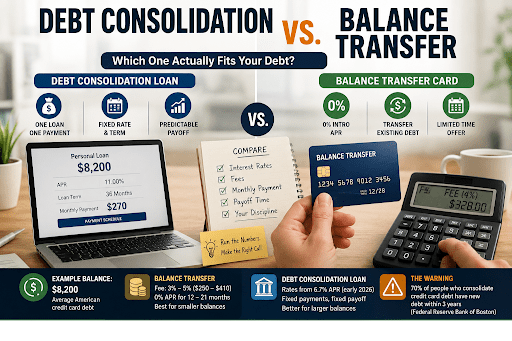
This is the part that decides most cases. As of early 2026, the interest rate for credit card balances that earn interest stands at about 22%, based on the data from the Federal Reserve. The rate for an average 24-month loan issued by banks is about 11%.That’s roughly half.
On $9,000 of debt, that gap is not small. It’s the difference between going to interest versus going toward the actual balance. Lower credit card interest rates would change this math, but most people carrying a balance are not getting a low rate. They’re getting whatever the card issuer set.
When a Balance Transfer Beats a Loan
There is one case where credit cards winIf you happen to get a balance transfer credit card with an introductory rate of 0%, and if you manage to clear your balance within this introductory period of 12 to 18 months, then your overall interest payments could be less than those made on a loan.
However, there is the problem of the transfer fee which is 3% to 5% of the amount that you shift, and also the increased interest rate if you do not manage to settle your balance in time. This route works best for smaller debts you’re confident you can clear fast. For anything you’ll be paying off over several years, a loan usually comes out ahead.
What a Fixed Monthly Payment Actually Buys You
A fixed monthly payment sounds boring, but it solves a real problem. With a credit card, your minimum payment can shift, and it’s easy to only pay that minimum while new charges creep back in. A personal loan locks the amount and the payoff date the day you sign. You know exactly when it ends.
That structure is also why a personal loan works well as a debt consolidation loan. Instead of juggling three or four card payments on three or four due dates, you make one payment, to one lender, until it’s gone.
The Downsides Nobody Mentions
A personal loan isn’t free money. Some lenders charge an origination fee, usually 1% to 8% of the loan, taken out before you get the cash. Applying also triggers a hard inquiry, which can dip your score a few points for a short while. And a loan only helps if you stop using the cards you just paid off. Pay off $9,000 in card debt with a loan, then run the cards back up, and you’re now carrying both.
Credit cards have their own hidden cost too. Carrying a high balance drags down your utilization ratio, which is a big piece of your credit score. That ratio improving is actually one of the quieter benefits of paying cards down with a loan.
How to Decide
Ask yourself three things. How much do you owe? How fast can you realistically pay it off? And what’s your credit like right now?
Larger balances, longer payoff timelines, and decent to good credit usually point toward a personal loan. Smaller balances you can wipe out within a year, paired with strong enough credit to snag a 0% intro offer, point toward a balance transfer. If your credit is rough on both fronts, a nonprofit credit counselor can look at real numbers with you before you commit to either one.
For a closer look at how balances and due dates affect your score month to month, Finance Cash Info’s credit and credit card guides walk through the details. And if you want the bigger picture on tackling what you owe, our loans and debt payoff guides cover strategies beyond just the loan versus card question.
Jake ended up going with a personal loan. Three payments became one, his rate dropped by more than half, and he had an actual date circled on the calendar for when it would be done. That last part, having an end date, was the thing that finally made the debt feel manageable instead of endless.
If you’re standing where Jake was, start by pulling your card statements and adding up what you actually owe. That number tells you more about which option fits than any article can.
FAQ
Is a personal loan always cheaper than credit card debt?
Usually, yes, because average personal loan rates run well below average credit card rates. The exception is a 0% intro balance transfer card, but only if you pay it off before the intro period ends.
Is a personal loan necessarily cheaper than credit card debts?
Generally, yes, due to lower interest rates on average for personal loans compared to credit cards, except for a 0% intro rate balance transfer card provided you manage to pay it off during the intro period.
Would applying for a personal loan affect my credit score?
It will most likely negatively impact your score through a hard inquiry. However, in the long term it will most likely help your score, as paying off the balance will reduce your credit utilization ratio, which counts more towards your score than the inquiry.
How long will it take me to pay off my debts via personal loan?
Personal loans usually last from two to five years and come with a fixed monthly payment. This means that you have a definite date by which you will be able to settle the debt.
What should my credit score be in order to obtain a debt consolidation loan?
Requirements vary by lender, but decent approval odds usually start in the mid-600s. Higher scores unlock lower rates, while lower scores may still qualify but at a higher cost.
Can I still use my credit cards after consolidating with a loan?
You can, but running the balances back up defeats the purpose. Many people keep one card open for emergencies and leave the rest unused after paying them off.